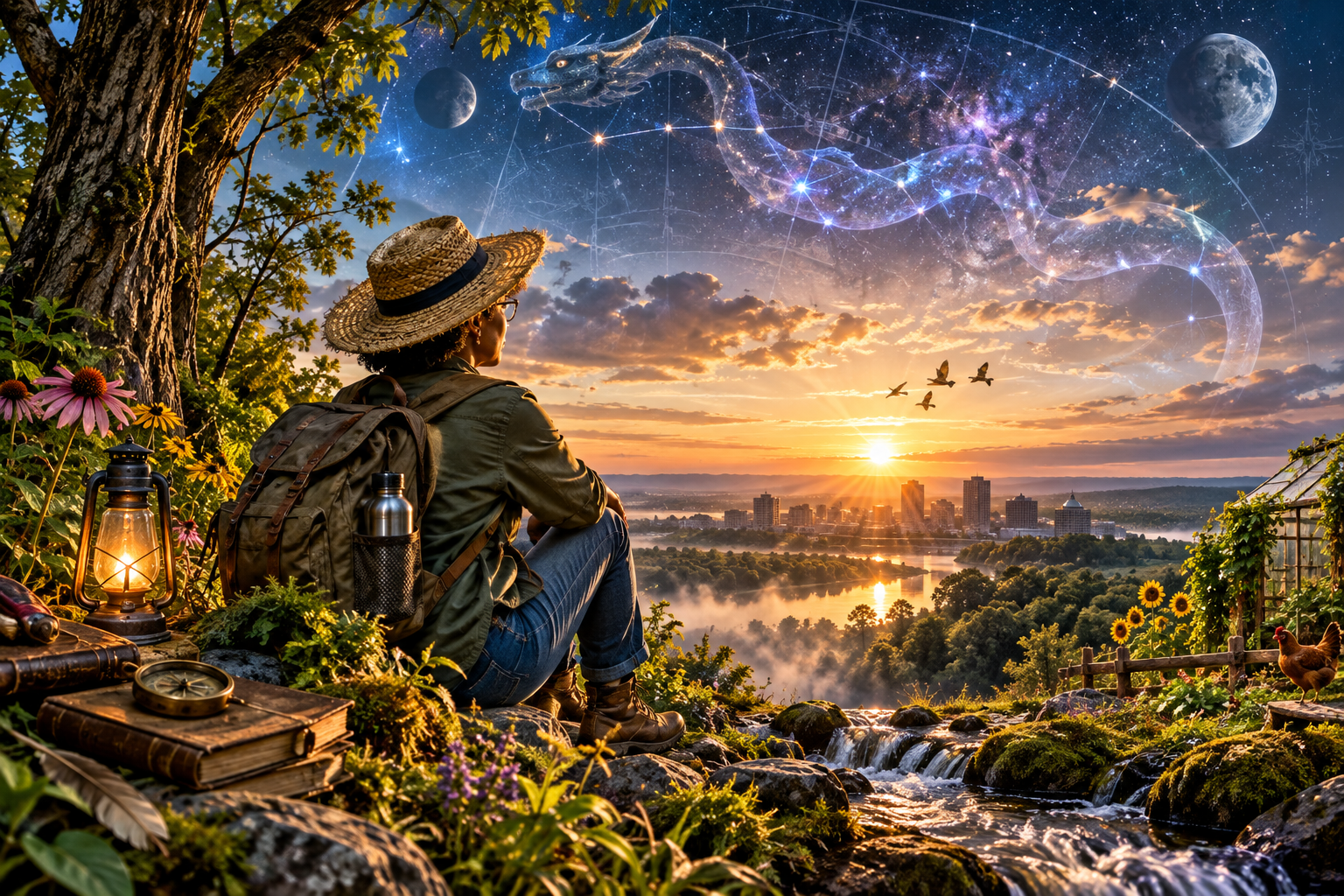
For Theodore Alvah Day Jr.
My brother.

and somehow have always been there.
CHAPTER 0
THE VOID
At 5:03 in the morning, the sky looked empty.
That was the first mistake.
The woman standing at the window did not know that yet.
She had awakened before dawn for no particular reason and wandered into the kitchen while the house remained dark. The refrigerator hummed. Pipes clicked somewhere behind a wall. Outside, September insects worked their invisible machinery beneath the trees.
Nothing extraordinary was happening.
She filled a glass with water.
Above the black outline of the houses, one white point burned brighter than everything around it.
She looked at it for several seconds.
Then she reached for her phone.
People of her century did that constantly. They held little rectangles toward things they did not understand and expected answers.
The device knew approximately where she stood.
It knew which direction she faced.
It knew the hour.
It knew the angle at which she tilted it toward the sky.
It knew more about that moment than nearly every human being who had ever lived before her.
And still, it could only show her a model.
She opened the sky application.
Stars multiplied across the screen.
Names appeared where darkness had been.
Lines connected lights that had never touched one another.
She turned slowly.
A translucent figure stretched across the artificial heavens.
It looked like skin.
Not human skin.
Something longer.
Something that had crawled out of itself and left its old shape hanging across the stars.
She moved the phone away from her face and looked directly through the glass.
Nothing.
She raised it again.
There it was.
A pale winding body.
She laughed softly.
“What in the world are you?”
The house did not answer.
Neither did the sky.
She touched the screen.
ERIDANUS.
The River.
She expected a serpent.
Instead, she got a river.
That amused her enough that she forgot the glass of water on the counter.
For several minutes she followed the constellation across the screen, moving the phone from one window to another as though the thing might somehow be hiding behind the house.
She did not know how far apart its stars actually were.
She did not know that the light reaching her eyes had left those stars at different times.
She did not know that there was no enormous river stretched across space.
There were only stars.
Distance.
Light.
Motion.
And a human mind drawing lines.
She took a screenshot.
That was all.
No revelation.
No prophecy.
No voice from the heavens.
No mysterious object crossed the sky.
No scientist received an alert.
No government detected an anomaly.
The screenshot entered the enormous accumulation of human information and became almost nothing.
A few million colored pixels.
Date.
Time.
Location data.
Device information.
A picture made by software interpreting a sky humans had been interpreting long before software existed.
Then she went about her morning.
The image remained.
•
Thirty-three years later, Theo found it.
He wasn’t looking for stars.
He wasn’t an astronomer, historian or archaeologist. He repaired things people had stopped manufacturing replacement parts for.
That had become a profession.
The workshop behind his house contained three generations of discarded technology: circuit boards, cracked tablets, obsolete medical sensors, two printers, copper wire, batteries, hand tools and plastic drawers filled with screws whose original purposes nobody remembered.
Theo rarely threw away a screw.
“You don’t know what it’s for,” his neighbor once told him.
“Exactly,” Theo answered.
He kept it.
On the morning he found the image, he was recovering photographs from an old storage device before its failing memory cells became unreadable.
Most were ordinary.
Food.
Flowers.
Receipts.
Children.
A cat staring suspiciously into a camera.
A blurry moon.
A medical appointment card.
Three photographs of the same tomato.
Then came the sky.
Theo stopped.
Across the image stretched a pale winding form.
He enlarged it.
The pixels softened.
ERIDANUS.
He had heard the name somewhere but couldn’t remember where.
Beneath the constellation was a faint grid.
Theo leaned closer.
For reasons he couldn’t explain, the grid interested him more than the stars.
He saved the image into a folder marked RECOVERED.
Then he returned to work.
That should have been the end of it.
It nearly was.
•
Outside Theo’s workshop, water moved beneath the ground.
People had spent centuries teaching water where to go.
They dug ditches.
Straightened rivers.
Buried streams.
Drained wetlands.
Built sewers.
Raised levees.
Poured concrete.
Laid pipes.
Dammed valleys.
Pumped aquifers.
Water occasionally obeyed.
More often, it waited.
Rain entered soil.
Roots pulled some upward.
Heat returned some to the atmosphere.
Some traveled through stone.
Some carried nitrogen.
Some carried salt.
Some carried metals.
Some carried molecules designed by human beings for purposes their inventors considered useful.
Some of those molecules lasted much longer than their usefulness.
Nothing in the water understood property lines.
Nothing in the water knew where one county ended.
Nothing in the water knew which factory had closed, which company had changed its name, which farm had been sold, which government had rewritten a regulation or which family had moved away.
Water simply continued downstream.
•
In another part of the world, ice surrendered something it had held longer than any nation had existed.
No one noticed.
The exposed material was smaller than dust and older than the language of the people who would eventually examine it.
For now, sunlight touched it.
Then wind.
Then water.
Nothing happened.
That mattered.
•
A child planted three seeds in a paper cup.
Her teacher had told the class to plant two.
The child put in a third because one might not grow.
When all three emerged, she refused to pull the smallest.
“They’re crowded,” the teacher explained.
The child considered this.
Then she found another cup.
Years later, nobody remembered the lesson.
The child did.
•
A machine in a hospital measured seven things in a tube of blood.
Another machine measured chemicals in drinking water.
Another measured moisture beneath a field.
Another counted vehicles crossing a bridge.
Another watched electrical demand rise during a heat wave.
Another recorded births.
Another recorded deaths.
Another calculated the probability that a loan would be repaid.
Another watched the movement of clouds.
Another tracked ships.
Another listened for earthquakes.
Another mapped stars.
The machines did not speak to one another.
Their databases had different owners.
Their measurements had different purposes.
Their specialists attended different conferences.
Their budgets came from different offices.
Their failures appeared in different newspapers.
Human beings had become extraordinarily good at measuring pieces.
They had not yet learned how many pieces belonged to the same thing.
•
Long before any of those machines existed, people looked upward.
They saw points of light and connected them.
A hunter.
A lion.
A fish.
A woman.
A ship.
A river.
The pictures differed between cultures because the stars did not provide instructions.
People supplied the lines.
Later they built instruments.
They measured angles.
They recorded movements.
They calculated.
They were wrong about some things.
They were astonishingly right about others.
The people who came after them laughed at certain mistakes while depending upon what those mistaken people had preserved.
This, too, would repeat.
Every age believed it stood near the edge of understanding.
Every age left notes for people standing farther away.
•
Theo returned to the recovered image that evening.
He had forgotten why it bothered him.
Then he saw it.
Near the bottom of the screenshot was a number.
2160.
Probably software.
Probably meaningless.
He enlarged it until the digits broke into squares.
2.
1.
6.
0.
He wrote the number on the back of an envelope.
Then the power went out.
The workshop fell silent.
Theo waited for the automatic system to restore it.
Nothing happened.
He sighed, reached beneath the bench and pulled out an old battery lantern.
His neighbor had laughed at that too.
The lantern worked.
Theo smiled.
“Exactly.”
•
Far above him, Earth continued a motion too slow for a human lifetime to witness.
It rotated.
It traveled around the Sun.
Its axis slowly changed orientation.
The stars appeared fixed only because human lives were short.
Mountains appeared permanent for much the same reason.
So did coastlines.
So did nations.
So did fortunes.
So did customs.
So did systems.
Given enough time, almost everything moved.
The difficulty was scale.
A person could understand tomorrow.
A family might think in generations.
A government might plan in decades.
A civilization could alter something that would remain long after everyone responsible for the decision was dead.
Consequences had no obligation to arrive during the lifetime of their causes.
That was the problem.
It was also the possibility.
•
Much later, people would give names to what followed.
Historians always did.
They would divide centuries into periods and periods into events. They would argue over where one age ended and another began.
They would search records for the moment everything changed.
Some would choose a war.
Some a migration.
Some a disease.
Some a machine.
Some a drought.
Some a discovery.
Some a birth.
They would be looking for a beginning.
They would not find one.
There wasn’t one.
There were billions.
A pipe installed.
A forest cleared.
A medicine discovered.
A child taught.
A river diverted.
A law passed.
A seed saved.
A lie repeated.
A stranger sheltered.
A measurement ignored.
A measurement remembered.
A screw placed in a drawer because someone thought:
You don’t know what it might be for.
The great mistake was believing that history moved because of great moments alone.
It moved through ordinary ones too.
Especially ordinary ones.
•
The old screenshot survived Theo.
So did the envelope.
For a time, they traveled separately.
The image entered an archive.
The envelope entered a box.
The box changed buildings three times.
Once it was almost discarded.
Someone wrote KEEP across its lid.
Nobody recorded who.
Decades passed.
Then more.
Languages changed.
Borders changed.
Machines became smaller.
Some cities became larger.
Others disappeared from maps.
Certain rivers returned to places from which people had removed them.
Forests grew through abandoned foundations.
People learned new ways to build.
They relearned old ways to grow food.
They forgot things their ancestors considered indispensable.
They rediscovered things their ancestors considered obsolete.
And above all of it, the stars moved so slowly that almost nobody noticed.
Eridanus remained a river because human beings kept calling it one.
The River.
A line through lights that were never actually joined.
Centuries after the woman at the window raised her phone toward the sky, another person opened the image.
By then, nobody knew who had taken it.
The metadata had been damaged.
The name was gone.
The location was uncertain.
The date survived only partially.
The researcher enlarged the image.
She saw Eridanus.
She saw the translucent skin.
She saw the grid.
Then she noticed something earlier archivists had missed.
Not 2160.
Something beside it.
Almost invisible.
A mark.
She magnified it.
Again.
Again.
The mark remained too damaged to identify.
She called another researcher over.
“What do you think that is?”
He stared.
“A defect?”
“Maybe.”
“Compression artifact?”
“Maybe.”
“A symbol?”
She didn’t answer.
Outside the archive, rain began falling.
It struck the roof.
Ran into gutters.
Entered storage tanks.
Overflowed into channels.
Passed roots.
Entered soil.
Joined water already moving beneath the ground.
Neither researcher looked outside.
They were still staring at the ancient picture.
Trying to decide whether two things were connected.
They had not yet learned the question.
The question was not:
What does the mark mean?
It was:
What happens if it means nothing?
And then:
What happens if it doesn’t?
Outside, the rain continued downstream.
Leave a Reply