CHAPTER 1
THE FIRST LINE
For eleven years, the narrow channel behind her house had spoken through the night. In spring it hurried beneath the old footbridge. In summer it whispered around exposed stones. During winter thaws it struck the concrete culvert with a hollow, steady knocking. Her grandmother had called it the house’s second clock.
Now the clock was silent.
Before the sun rose, Mara stood barefoot at the kitchen window, watching the dark yard. A single security light illuminated the bridge. Beyond it, the trees stood motionless beneath a September sky. The house’s environmental display reported normal pressure, normal humidity, and an uninterrupted municipal water supply.
None of those measurements described what she could hear.
She put on boots, lifted the emergency lantern from its charging cradle, and went outside.
The channel was empty. Not dry: its stones shone with moisture, and a thread of water still moved beneath the leaves. But the stream that had crossed this property before her grandparents were born had vanished between sunset and dawn.
Mara photographed the channel from the bridge. She photographed the wet marks on its banks. Then she walked upstream, keeping one boot on the bank and the other on the path where possible.
At the boundary fence, the stream disappeared into a new mound of pale gravel.
Someone had buried it.
She knew whose machines had arrived yesterday. She also knew the development company had obtained every permit its lawyers believed necessary. Her own complaints about the project had received three acknowledgments, two automated summaries, and no meaningful answer.
The gravel was still warm where the machines had worked.
Mara crouched and placed her palm against it. Beneath the stones she felt a faint vibration, as though something immense were clearing its throat.
Her phone announced that she had entered private property.
She stood up.
“I’m not on it,” she told the device.
The phone offered to document the dispute.
“You can start by documenting the water.”
It displayed a map. A blue line ran neatly through the new construction site, turned at a right angle, and continued beneath a proposed parking structure. According to the map, the stream was exactly where it belonged.
According to the ground, it was somewhere else.
Mara took another photograph.
At the breakfast table, her younger brother Eli watched her spread printed maps beside a bowl of cooling oats. He had come to stay while the regional transit system repaired a bridge near his apartment. The repair had been scheduled for six days. It was entering its fourth month.
“Call the county,” he said.
“I did.”
“Call again.”
“They’ll send me the same map.”
Eli examined the photographs. “Maybe the contractor diverted it properly.”
“Then why did it disappear overnight?”
She turned one map sideways. It was older than the house, printed from a survey that showed the property before the road, the subdivision, or the concrete channel. The stream wandered across a broad patch of marsh. Its course resembled a question mark.
On the newer map, it resembled a ruler.
“They straightened it twice,” Mara said.
“People have been doing that forever.”
“Yes.”
He looked up. “You said that like it’s a bad answer.”
“It’s an incomplete one.”
Her phone chimed. The developer’s public information service had replied to her overnight message. Its summary explained that engineered drainage would improve land utilization while maintaining required downstream flow. A bright illustration showed smiling people walking beside a landscaped pond.
There was no pond on the site. There was no visible water either.
Mara forwarded the message to Eli.
“That’s not proof they’re wrong,” he said.
“I know.”
She surprised him by gathering the maps instead of arguing. Then she opened a cupboard and removed an old measuring tape, a notebook, and a small wooden level that had belonged to their grandfather.
“Where are you going?”
“To find out where the water went.”
“By yourself?”
“Unless you’re coming.”
He looked at the oats. Then at his sister. Then he reached for his boots.
They followed the buried line toward the road. There, a maintenance cover trembled against its frame.
Eli stepped back. “That doesn’t sound right.”
Mara heard the water now. Not flowing freely, but striking something hollow beneath the pavement. Each impact produced two notes, one deep and one thin. The second note came later, after a pause that seemed too regular to be accidental.
She recorded thirty seconds of sound.
A delivery vehicle passed, masking the rhythm. When the road quieted, the knocking returned.
“Maybe there’s a blockage,” Eli said.
“Maybe.”
“Don’t open that.”
She hadn’t intended to. A confined drainage system could conceal sudden flow, unstable covers, dangerous air, and a fall no one would survive. She marked the cover’s location and moved away from the road.
At the next crossing, a thin fan of muddy water emerged from a seam in the pavement. It traveled toward a storm drain that served another watershed.
Mara stared at it.
“That’s new,” Eli said.
She took a sample in a clean container, labeled it with the time and place, and photographed the label beside the crossing. She did not taste or touch the water. The sample would tell them little without proper analysis, but a chain of ordinary observations was better than a dramatic accusation unsupported by evidence.
Eli called the municipal emergency line to report possible drainage failure. The operator gave them a reference number and advised them to remain clear of the construction area.
Mara wrote the number in her notebook.
“There,” Eli said. “Someone’s handling it.”
“Someone’s recorded it. That’s different.”
By noon, the sun had warmed the pavement. Mara returned to the first bridge and discovered that the exposed stones were drying unevenly. A dark strip remained along the eastern bank, where a stand of nettles grew beside a fallen tree.
She followed the strip with her eyes. It continued beneath the leaves, crossed the path, and vanished under her neighbor’s vegetable beds.
Water had not disappeared. It had found another route.
Her neighbor, Mrs. Vale, emerged carrying a basket of beans. She had lived there long enough to remember when the footbridge was only two boards laid across mud.
“You’re looking at my garden,” she said.
“Is the ground wetter than usual?”
“My carrots are drowning.”
Mrs. Vale set down her basket and pointed toward the far fence. The soil beside it had sunk overnight. A young pear tree leaned toward the depression, its roots exposed on one side.
Mara photographed the tree without stepping onto the softened ground.
“You think they’ll pay for that?” Mrs. Vale asked.
“I don’t know yet.”
It was the first honest answer Mara had given all morning that felt like a failure.
Mrs. Vale studied her. “Your grandfather would have known where that stream was going.”
“He isn’t here.”
“No. But he left you his notebooks.”
Mara looked toward the house.
She had forgotten the notebooks.
They occupied two cardboard boxes beneath the stairs, packed when her grandmother died. Most pages recorded household repairs, planting dates, temperatures, and the peculiar behavior of the spring. Her grandfather had written in a cramped hand that became almost illegible whenever he was excited.
On the third notebook’s back cover, Mara found a hand-drawn map. A dotted line crossed the property beneath the current channel and continued toward Mrs. Vale’s garden. Beside it, her grandfather had written: OLD BED. STILL RUNS IN HEAVY RAIN.
Eli whistled.
“He knew,” Mara said.
“He suspected.”
At the bottom of the map was a sentence underlined twice.
Water remembers the low places.
Mara read it aloud.
Eli frowned. “Water doesn’t remember anything.”
“No,” she said. “But the ground does.”
The distinction pleased her. She copied it into her own notebook, then added a question: If the buried channel fails, which low place fills first?
She did not have to wait long for an answer.
At three in the afternoon, Mrs. Vale called. The depression beside her pear tree had widened. Muddy water was rising through the soil, and the fence had begun to lean.
Mara told her to move away from the area and keep everyone clear. She called the emergency line again, supplied the earlier reference number, and reported the changing conditions. Eli sent their photographs and the old map through the official incident portal.
The system accepted every file. It then informed them that their report might take forty-eight hours to review.
Mrs. Vale’s fence shifted while they watched.
A section of ground collapsed with a sound like a heavy door slamming underground. Water burst through the opening, carrying gravel, leaves, and a piece of orange construction fabric.
Eli pulled Mara backward by her coat.
For several seconds neither spoke.
Then Mara called again. This time she reported an active ground collapse and requested immediate assistance. The operator instructed them to keep people away and said crews were being dispatched.
Within twenty minutes, a municipal vehicle arrived. Its driver placed barriers across the path. Two engineers followed, one carrying a tablet, the other a long measuring rod. They listened while Mara explained what she had observed, then inspected the collapse from stable ground.
The older engineer examined her grandfather’s map.
“Where did you get this?”
“Under my stairs.”
He smiled without amusement. “Best place for an old river to hide.”
The younger engineer enlarged the photograph of the trembling maintenance cover. “We need to check upstream.”
Mara pointed toward the construction fence.
The older engineer made a call. This time someone answered immediately.
By evening, work on the site had stopped. Pumps arrived. Crews established a safety perimeter and began tracing the buried drainage line. The official statement described an unexpected interaction between historic subsurface flow and recent earthworks. The cause remained under investigation.
Mara read the statement twice.
Unexpected to whom? she wondered.
She did not post the question. She had learned enough that day to distrust the pleasure of being first with an accusation. Instead, she uploaded the dated observations, the incident number, and the old map to a public neighborhood archive. She included a warning that the sample she had collected was untested and should not be treated as evidence of contamination.
Eli watched her choose a title.
“You’re making this bigger,” he said.
“It already is bigger.”
“You know what I mean.”
She did. Their neighbors would read it. The developer might challenge it. Strangers would add rumors. Someone would claim that the old map proved things it could not possibly prove.
Mara considered keeping the archive private.
Then she remembered Mrs. Vale standing beside the sinking tree, asking whether anyone would pay for what had happened.
She titled the record THE WATER WE COULDN’T SEE.
“I don’t want people to believe me,” Mara said. “I want them to check.”
Eli sat beside her. Together they added instructions for photographing fixed landmarks safely from public ground, reporting sudden changes, and avoiding unstable soil. They left out the construction company’s name until the investigation could establish what had happened.
Before bed, Mara returned to the bridge. Temporary lights glowed beyond the trees. The familiar channel remained almost empty, but beneath the bridge she could hear a small trickle returning.
She switched off her lantern.
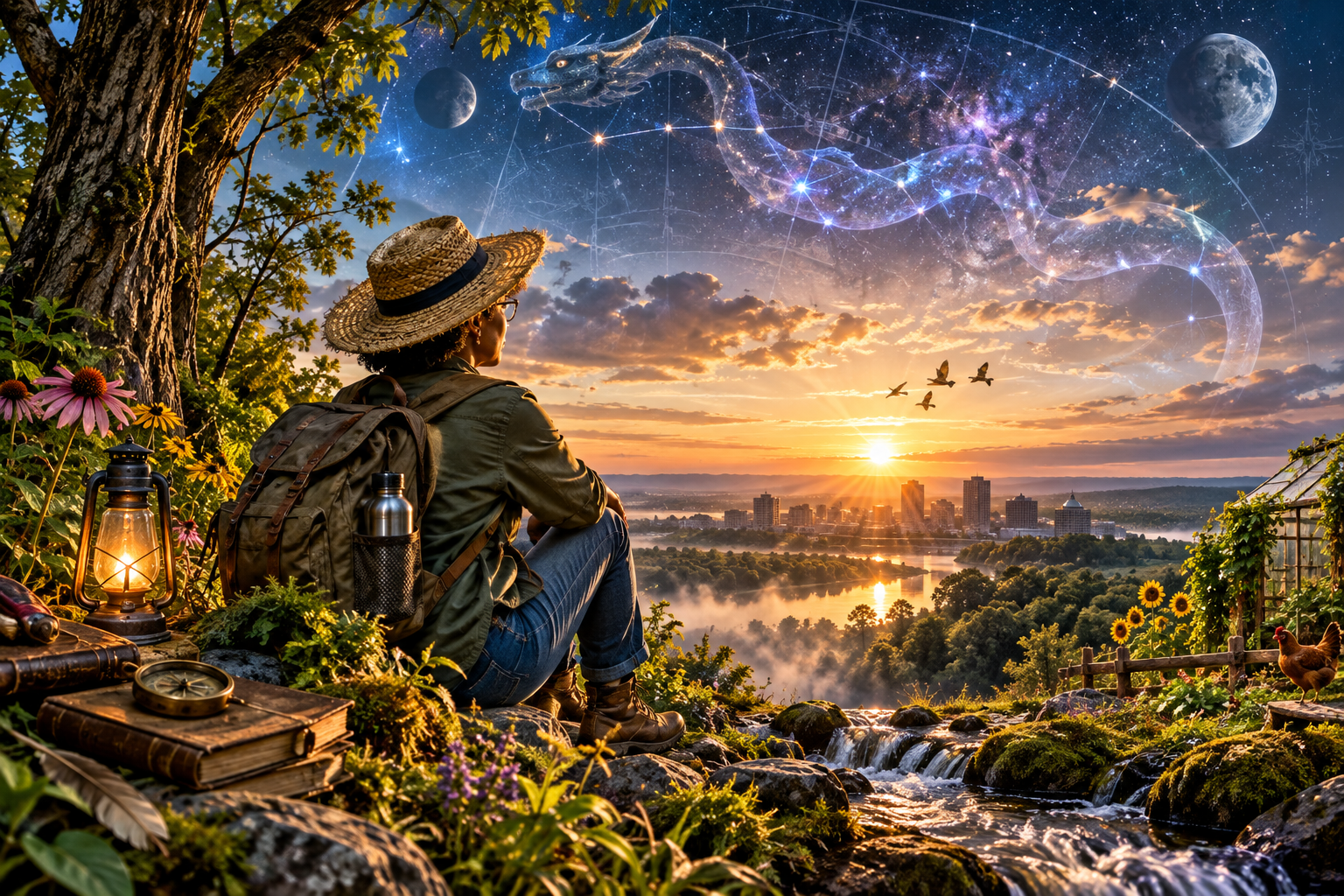
Without its light, the sky seemed crowded. A pale band of cloud moved past a single bright star. Mara opened an old astronomy application she had recovered from her grandmother’s files. Its graphics were primitive, its location estimate imperfect, and several of its labels had shifted during decades of updates.
A translucent river appeared across the screen.
ERIDANUS.
She smiled at the coincidence. Her grandmother had saved dozens of sky pictures. Perhaps this was one of them. Mara searched the recovered folder and found an image dated thirty-three years earlier, taken before she was born.
The same river occupied the screen.
She enlarged it. Near the lower edge was a faint grid, partly hidden by the application controls. Beneath it, a number survived in four small digits.
She saved the image and returned to the bridge.
The trickle had grown louder. It followed the channel for several feet, then slipped sideways through a crack and vanished beneath the bank.
Mara watched it disappear.
Tomorrow, the engineers would bring better instruments. They would measure slopes, inspect pipes, compare records, and perhaps discover who had overlooked the older watercourse. Their work mattered. So did the permits, the maps, and the people who had tried to follow them.
But the first useful measurement had been silence.
Mara entered one final observation in her notebook: 21:16. Flow audible. Surface route incomplete.
She paused before closing it.
On the next page she drew a single line, beginning at the buried spring and ending at the place where she stood. She left the rest of the page blank.
There were other houses downstream.
Tomorrow she would find out how many.
Leave a Reply