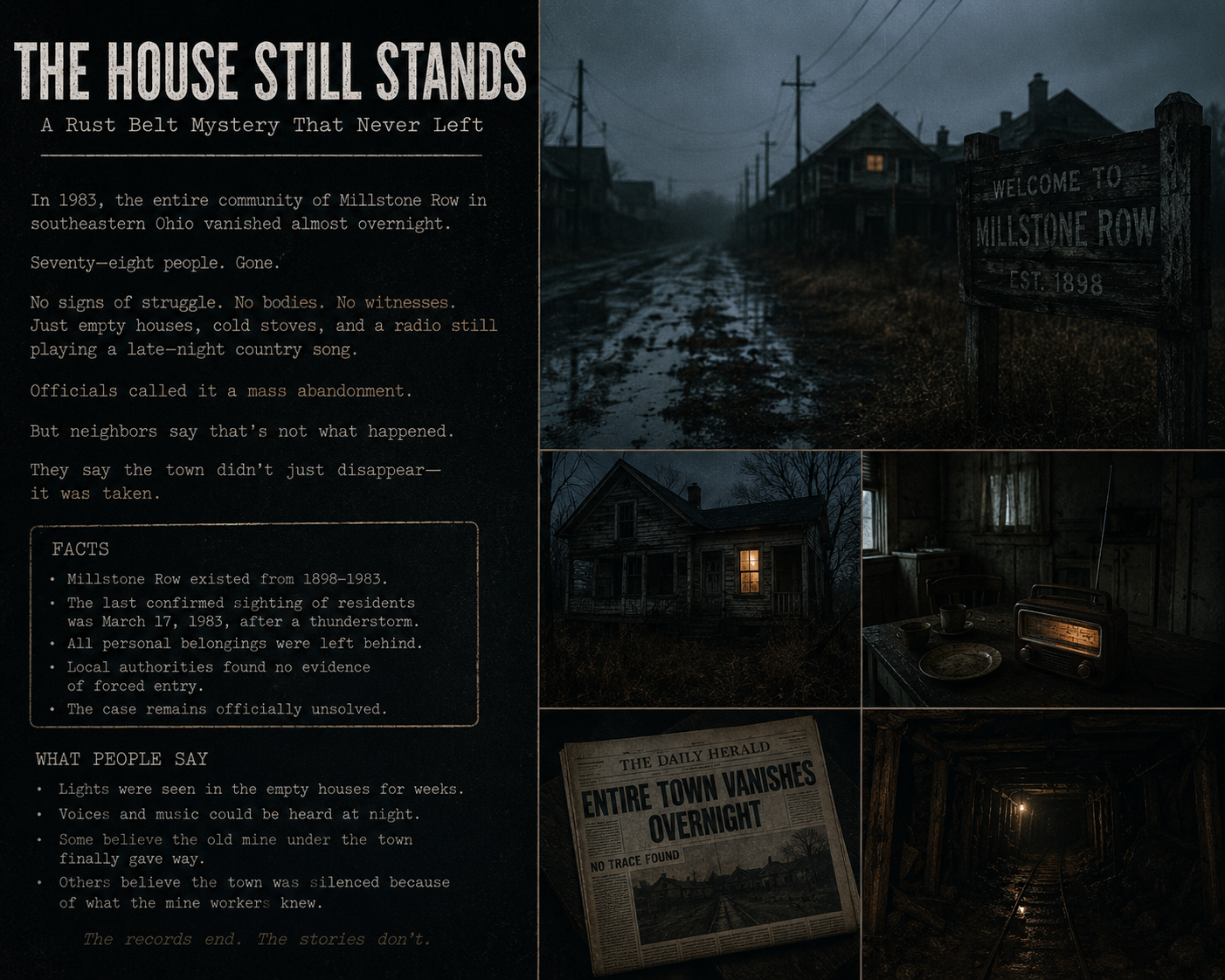
Centralia, Pennsylvania, did not die all at once.
It disappeared slowly.
First went the easy things: a neighbor’s porch light, a church bell, a storefront window with dusty cans still lined up behind the glass. Then came the homes. Then the streets. Then even the ZIP code was gone.
But beneath the empty lots, the fire kept breathing.
The fire began in May 1962 in abandoned mine workings beneath Centralia’s Buck Mountain coal bed, and it has burned underground for more than sixty years. Pennsylvania’s Department of Environmental Protection says the fire reportedly started near a borough landfill and spread into old coal mines under the town.
People tried to live with it at first.
That is the part that feels impossible now.
Imagine being sixteen and walking to school while the ground steams beside the road. Imagine adults telling you not to worry while smoke curls from cracks in the earth like the town itself has started exhaling.
Centralia had once been a mining town. Coal built it. Coal fed families. Coal put shoes on children’s feet and black dust on their fathers’ hands.
Then coal turned against them.
By the late 1970s and early 1980s, the danger was harder to ignore. Toxic gases, unstable ground, and heat from below made daily life feel less like home and more like a warning. One famous incident happened in 1981, when 12-year-old Todd Domboski fell into a sudden sinkhole and survived after clinging to a tree root until his cousin pulled him out. Hot steam and dangerous gases came from the hole.
After that, the town’s fear had a shape.
A boy-sized hole in the earth.
Federal relocation money came in the 1980s, and many residents accepted buyouts. In 1992, Pennsylvania condemned the remaining buildings through eminent domain, and in 2003 Centralia’s ZIP code was discontinued.
Most houses were torn down.
Not burned.
Not swallowed dramatically.
Just removed, one by one, until streets led nowhere and steps climbed to empty air.
Today, Centralia is not exactly a ghost town in the movie sense. A few residents were later allowed to remain for life under a 2013 agreement, but the town most people knew is gone.
Still, visitors come.
They come looking for smoke.
For cracked pavement.
For proof that a town can be erased while the disaster underneath it keeps going.
And that is where the story becomes something more than history.
Because Centralia feels less haunted by ghosts than by consequence.
The horror is not that something invisible lives beneath the town.
The horror is that something invisible was always there — old mines, old decisions, old damage — waiting until the ground finally told the truth.
A fictional girl named Lena, sixteen, might stand there on a gray afternoon, looking at an empty road where homes once stood.
She would not hear screams.
She would hear wind.
She would see dead grass, warning signs, and the occasional breath of steam rising from the earth. She might imagine a kitchen that no longer exists. A mother calling someone inside. A boy’s bike leaning against a porch that was demolished years ago.
And then she would understand the worst part.
Some places do not need to be haunted.
Some places are evidence.
Centralia still burns beneath the surface, and estimates have suggested the fire could continue for generations.
The town is mostly gone.
The fire is not.
And on cold days, when vapor rises from the ground, it can look almost like the earth is remembering how to breathe.
Leave a Reply