Wicked Grim Stories | Dayton History & Community Legacy | By Esi Noire
Not every old neighborhood hides a terrible secret. Some hold the memory of people who made life better for everyone around them.
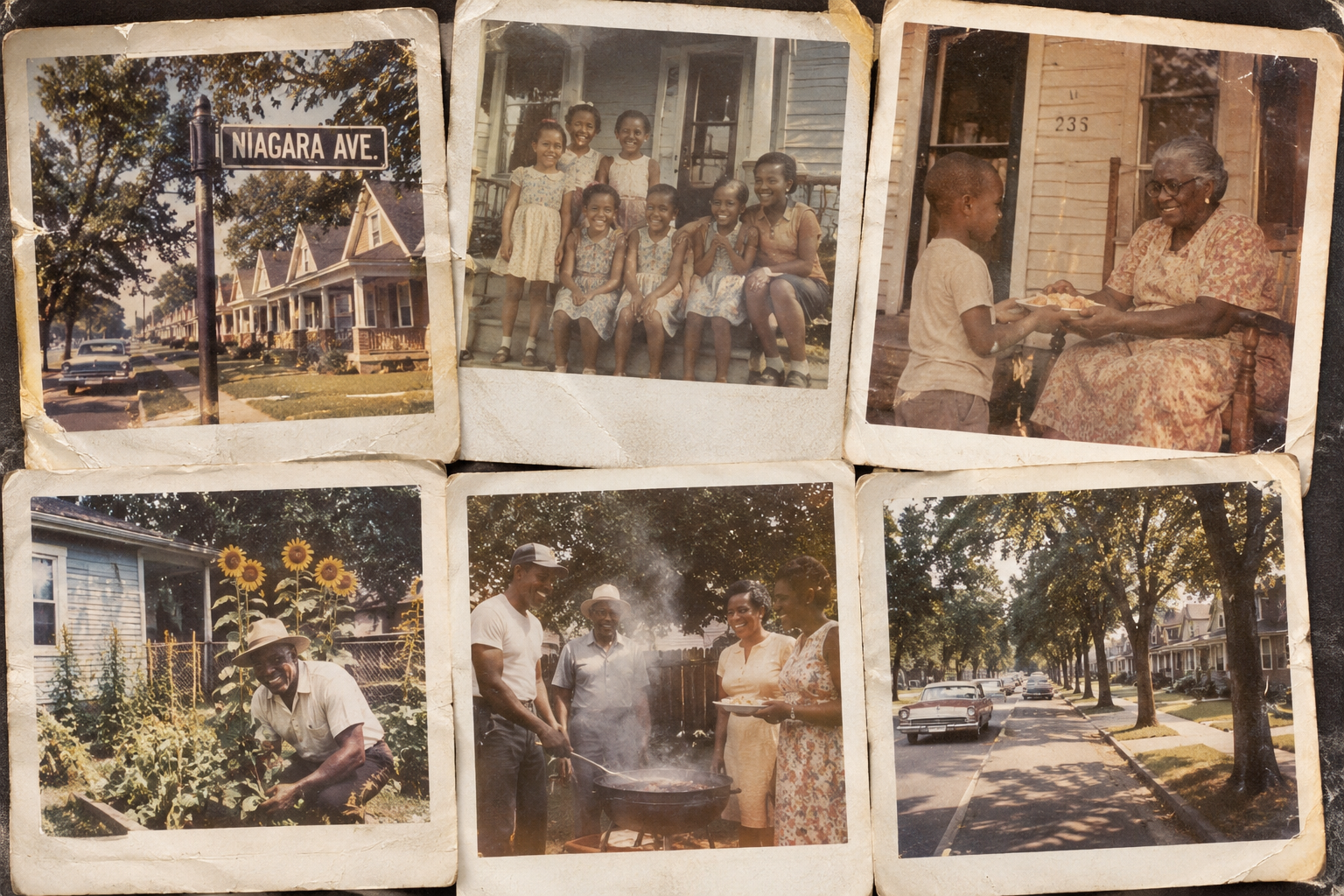
Illustrations accompanying this feature are historically inspired, not archival photographs of Niagara Avenue.

A Neighborhood Is More Than Its Buildings
Walk along an older residential street in Dayton, Ohio, and you may notice the things that have survived: a porch railing, a mature tree, a narrow driveway, a weathered set of steps. But what about the things you cannot see? Who planted that tree? Who helped a neighbor carry groceries? Who opened their door when somebody needed a meal, advice, or simply somewhere safe to sit? These are questions worth asking about Niagara Avenue—and about hundreds of other streets throughout Dayton. Sometimes the greatest mystery isn’t what happened inside a house. It’s who lived there, whom they helped, and whether anyone remembers. Throughout the twentieth century, Dayton experienced industrial expansion, migration, changing neighborhoods, and housing discrimination. Families built lives around workplaces, churches, schools, small businesses, and the people living next door. Think of a woman who watched neighborhood children after school, a mechanic who repaired a struggling family’s car, or a neighbor who made sure an elderly resident had food during a snowstorm. These are illustrative examples, not verified accounts of particular Niagara Avenue residents.

The Dayton Neighbors Who Refused to Disappear
One documented example of neighborhood courage comes from Dayton’s historic East End, particularly the Irwin area. For decades, residents lived under the shadow of industrial zoning that threatened the future of their homes. By the early 1970s, neighborhood advocates were repeatedly appealing to city officials. Among them were Herman Lander, Charles Stone, and Reverend Ruby Daniel. Mrs. Clarence Porter also appeared before Dayton’s City Plan Board in May 1973, standing with neighbors determined to defend their community. Their efforts were about more than property lines. They were about belonging, stability, and the right to remain in the place they called home. According to research published by the Ohio History Connection, Reverend Ruby Daniel described the neighborhood as a family. Children visited her porch for sweets from her candy shop. She also fought to improve Daniel Temple of All Nations Holiness Church of God, but industrial zoning stood in the way of her plans for a steeple. In June 1973, part of Diamond Avenue received residential zoning, although the struggle did not deliver everything residents sought. Ruby Daniel never got her steeple. But the record of her determination remains.
What Does This Have to Do With Niagara Avenue?
Niagara Avenue is our starting point, not a claimed location for the Irwin neighborhood events. At present, we have not verified the identities or charitable deeds of former Niagara Avenue residents from fifty or one hundred years ago. That is a mystery still waiting for research. Dayton’s city directories, historic newspapers, census records, deeds, photographs, and oral histories offer ways to begin. The Dayton Metro Library’s Dayton Room preserves local historical material. Preservation Dayton also explains how directories and maps can help reconstruct a home’s history. A name in a directory might lead to an occupation. An occupation might lead to a newspaper article. A newspaper article might reveal a church, neighborhood association, or act of service. And a family photograph might bring that story back to life.

The Good We Leave Behind
We often measure a person’s life by what they owned, where they worked, or how much money they accumulated. But neighborhoods remember people differently. Sometimes they remember the woman who always had an extra plate, the grandfather who taught children to repair bicycles, the neighbor who planted flowers where there had only been weeds, or the person who stood before city officials and insisted that an ordinary community deserved to survive. Not every good deed was documented. Not every generous person received recognition. And not every story has a happy ending. But those lives still mattered.

A Different Kind of Historical Investigation
The Good Karma Files will look for the overlooked people who helped build, protect, and care for their communities. We will seek documented stories, listen to family memories, and distinguish established facts from legend. Some discoveries may be joyful. Others may reveal how much courage ordinary kindness required. Sometimes the most valuable discovery may be a name that almost disappeared. So the next time you pass an old house, consider a different question. Not “Who died here?” but “Who made somebody else’s life better here?” Perhaps their good karma is still moving through the neighborhood.
Help Preserve Dayton’s Good Karma
Do you remember a Dayton neighbor, teacher, shopkeeper, church member, gardener, or ordinary person who made a lasting difference between the 1920s and 1970s? Share the story, approximate decade, and any historical evidence you have. Please avoid posting private information about current residents. The past isn’t only a record of what went wrong. It’s also a record of the people who tried to make things right. Every voice matters, and every truth deserves to be heard.
Leave a Reply