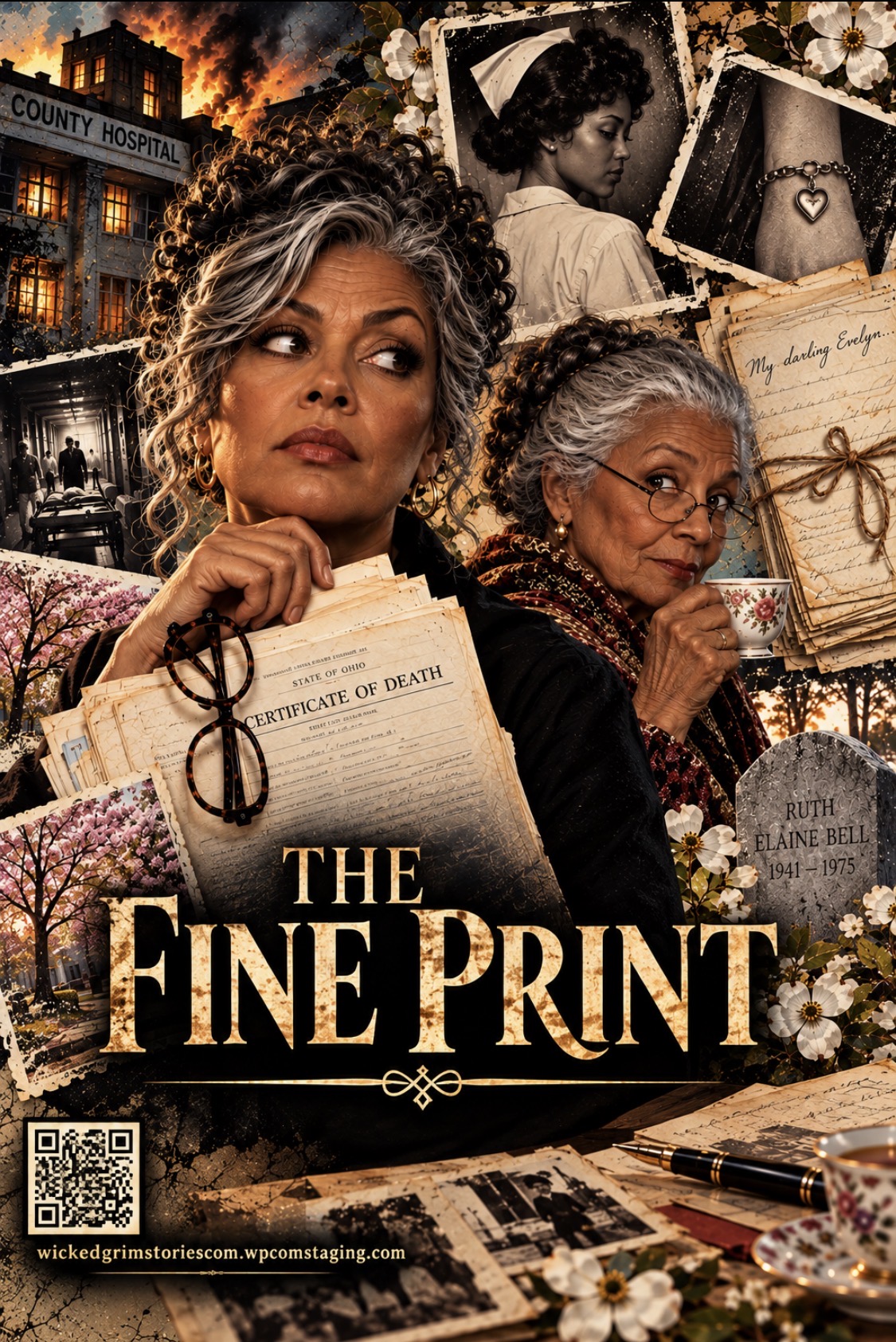
WICKED GRIM STORIES · EPISODE TWENTY-SIX
The Fine Print
By Esi Noire
The last correction in the green ledger was not written in ink.
It was written on a sheet of plain white paper, folded into quarters and tucked between the back cover and the binding.
For thirty-two years, nobody had noticed it.
The sheet was not a confession.
It was not a list of names.
It was a question.
Who gets to read the record after we are gone?
Miriam Bell found it on a Tuesday morning, six weeks after retiring from the Bellwether County Records Office.
By then, she had grown tired of people congratulating her on having nothing to do.
She had plenty to do.
She simply preferred that none of it involve a county-issued telephone.
Yet here she was, standing in the archives again, with a newly discovered page in her hand.
“Don’t tell me,” said Patrick Sloan, the county attorney, when he saw her.
“Another secret book.”
“Worse,” Miriam said. “A question somebody expects us to answer.”
The county had agreed to preserve the green ledger and its supporting documents.
That part had been relatively easy.
A climate-controlled cabinet had been assigned.
An archivist had cataloged the book.
The legal office had approved a review process for records containing private information.
The historical society had prepared an exhibition explaining how an informal group of clerks and community advocates had preserved original documents when official corrections were unsupported.
The problem was access.
The book was safe.
But safety and usefulness were not the same thing.
A woman whose grandfather’s housing record had been corrected incorrectly could not travel across the state merely to inspect a document under supervision.
A family that did not know the ledger existed could not request it.
And a person whose name had been misspelled in an index might never find the record at all.
Miriam had spent her career protecting documents from damage.
Now she wondered whether the greatest danger was making them so difficult to see that they might as well have been lost.
The white sheet was dated September 1994.
Its handwriting matched that of Harold Voss, the records employee who had hidden the green ledger behind a false panel during a courthouse renovation.
Beneath the question, he had written three lines.
The originals must remain.
The corrections must be visible.
The people must be able to find both.
There were no initials.
No signature.
Miriam recognized the reasoning immediately.
It was the same principle that had begun with Lenora Price in 1958, when she insisted that a housing-hearing record should not be changed without preserving what had first been written.
Dorothy Keene had kept a copy.
Evelyn Cross had checked another record.
Florence Mercer had saved the envelopes that proved twelve certified notices had been marked delivered to people who were already dead.
Harold had protected the ledger.
Different people.
Different decades.
The same refusal to let a newer version erase an inconvenient older one.
The initials R.E.C. had eventually given the practice a name: Record Evidence Comparison.
But Harold’s question was larger than the method.
What good was the truth if the people who needed it could not reach it?
Miriam invited the families, archivists, and county staff who had helped reconstruct the history to a meeting.
She insisted that the meeting take place in the public library rather than the courthouse.
Patrick asked why.
“Because a library is where people go expecting to find things,” she said.
“And a courthouse?”
“Where they go hoping they won’t be asked to pay for something.”
Patrick gave her a look.
Miriam took it as appreciation.
They arranged folding chairs in a circle.
Nadine Mercer came with her mother, Ruth.
Imani Finch brought the historical society’s preliminary exhibit.
Thomas Price, Lenora’s son, arrived with a folder of family photographs.
Elise Pike brought copies of her mother’s reporting on Alder Court.
David Renner, Alice Renner’s grandson, carried a letter his grandmother had written after her second housing hearing.
And Helen Whitcomb brought a receipt showing the fee her family had paid to clear an assessment they had never been properly notified about.
Nobody at the meeting had the same story.
That was the point.
Patrick opened with a careful explanation of the county’s proposal.
The original ledger would remain protected.
A digital index would identify entries that could be made public.
Records containing sensitive information would be reviewed before release.
Families could request copies of documents relating to them.
The archive would publish explanations distinguishing verified corrections, disputed changes, and unresolved claims.
It was a sensible plan.
Miriam thought so.
Then Helen raised her hand.
“How would I know to request something if I didn’t know it was there?”
Patrick paused.
The question was fair.
“We could publish a list of names,” he said.
“Some of those names belong to people whose families are still living,” Nadine replied. “Not everyone wants a private dispute on the internet.”
“That is also fair,” Patrick said.
Imani leaned forward.
“So we need a way for people to find relevant records without putting everyone’s business on public display.”
The room fell silent.
For once, the silence was productive.
They spent two hours discussing what the collection should become.
Thomas wanted the story of his mother included, but he did not want her turned into a saint.
“She was stubborn,” he said. “Sometimes she was wrong. She once argued with a bus driver for twenty minutes before realizing she was standing at the wrong stop.”
Ruth laughed.
“That sounds like somebody who could start a records movement.”
Thomas smiled.
“She didn’t start a movement. She helped a neighbor.”
Miriam wrote that down.
Elise argued that the exhibit should include cases where the original record was wrong and the correction was justified.
Otherwise, visitors might assume that every amended document concealed wrongdoing.
Nadine agreed.
“A correction can be necessary,” she said. “The question is whether the evidence supports it.”
David asked that the people affected by the records be treated as more than examples of administrative failure.
“My grandmother lived another thirty years after that hearing,” he said. “She worked. She raised children. She grew roses. That file was part of her life. It wasn’t her whole life.”
Miriam underlined the sentence twice.
The library’s local-history librarian, Clara Benton, proposed a compromise.
The archive could publish a searchable collection guide describing the kinds of records held and the years covered.
Names could be included where release was appropriate.
For restricted entries, people could make a confidential inquiry using names, dates, or property information.
Staff would review requests and explain what could legally be shared.
The public exhibit would use consented stories and redacted documents.
And each record would show its history clearly: original, amendment, supporting evidence, and any unresolved dispute.
No one would have to guess which version they were reading.
Patrick considered the plan.
“It will take time.”
Clara nodded.
“It should.”
“It will take money.”
“Yes.”
“It may generate complaints.”
“Almost certainly,” Miriam said.
Patrick sighed.
“You’re enjoying this.”
“Only the part where we’re finally discussing how people will use the records.”
They called the project The First Copy Collection.
The name came from Lenora Price’s request in 1958.
Please keep the first copy until someone can explain why it was changed.
The historical society wanted to call the exhibit The R.E.C. Files.
Miriam objected.
“It sounds like a television program where every answer arrives before the commercial.”
Imani laughed.
“It’s memorable.”
“So is a fire alarm. That doesn’t mean you want one in your living room.”
They settled on a title for the public exhibition:
THE FINE PRINT: WHAT THE RECORD LEFT OUT
It was not a claim that every record contained a lie.
It was an invitation to read carefully.
The subtitle explained that the collection explored original documents, corrections, and the people who preserved evidence when official accounts were disputed.
For the first time, the green ledger had a place in the public story without being mistaken for the entire story.
The work was slower than anyone expected.
A single page could require several decisions.
Could a name be released?
Was the person living?
Did the document contain private financial or medical information?
Was the correction supported by an original source?
Had the family been contacted?
What remained uncertain?
Miriam volunteered two mornings a week.
She was not permitted to supervise anyone.
She considered that an unnecessary restriction.
Clara reminded her that retirement was supposed to involve fewer responsibilities.
Miriam replied that the word supposed had caused a remarkable amount of trouble in government.
They worked anyway.
One afternoon, they came to an entry involving a school employee dismissed for an absence.
The green ledger suggested that the absence had been approved.
But the original approval form was missing.
A later letter from the employee disputed the dismissal.
There was no evidence proving which account was correct.
Clara asked how to describe it.
Miriam considered the file.
“Unresolved,” she said.
“That’s all?”
“That’s all we know.”
Clara nodded and typed the word.
Miriam felt an unexpected satisfaction.
For years, she had watched people use confident language to cover uncertainty.
Here, at least, uncertainty would be allowed to remain visible.
As the exhibition took shape, a disagreement arose over the twelve certified letters.
Nadine wanted the reproduced signature of Evelyn Cross displayed beside a photograph of Evelyn taken during her years as a records examiner.
Helen objected.
“People will think she signed those receipts,” she said.
“That’s exactly what we’re explaining she couldn’t have done,” Nadine answered.
“Then make it clear.”
They studied the proposed caption.
It read:
Evelyn Cross’s signature appears on twelve certified delivery receipts dated five years after her death.
Helen shook her head.
“That’s true, but it isn’t enough.”
Miriam rewrote it.
These receipts used a reproduction of Evelyn Cross’s signature after her death. The surviving evidence does not show that she authorized their use. The receipts cannot establish delivery to the deceased property owners.
Helen read it.
Then nodded.
“Now that’s a correction.”
Thomas Price donated a copy of his mother’s photograph.
He kept the original.
Beside it, the exhibit described Lenora’s work helping neighbors understand official correspondence.
There was no portrait of her as a fearless crusader.
No suggestion that she had single-handedly created the Record Evidence Comparison procedure.
Instead, the display showed the hospital slip, the hearing-room receipt, Dorothy Keene’s letter, and the later memorandum.
Visitors could follow the evidence themselves.
Thomas stood before the completed display.
“That’s her,” he said.
Imani asked whether he meant the photograph.
“No,” he replied. “The part about keeping a copy.”
He pointed to a line describing Lenora’s insistence that families retain their paperwork.
“She used to tell people to keep receipts in a biscuit tin if that was all they had.”
He smiled.
“She’d be pleased somebody finally gave the biscuit tin a proper shelf.”
On opening day, the library filled slowly.
There were no television crews.
No ribbon-cutting ceremony.
No grand speech by a politician claiming credit for work begun before most of the audience had been born.
A few county officials attended.
Several retired clerks came.
Families arrived carrying photographs and questions.
A young woman brought a letter from her grandfather’s estate.
An older man wanted to know whether the county had records of a demolished neighborhood.
A former school secretary said she remembered making carbon copies because she did not trust the office copier.
Miriam stood near the entrance, watching people read.
Some moved quickly through the exhibit.
Others stopped at a single page for a long time.
No two visitors seemed to notice the same detail.
That pleased her.
The collection was doing what it was supposed to do.
It was allowing people to look for themselves.
David Renner stood beside his grandmother’s case.
The display included her hospital admission record, the corrected attendance sheet, and the letter in which she thanked Lenora Price.
It also included a photograph David had provided.
Alice stood in a garden, wearing a broad straw hat, one hand resting on a rosebush.
A visitor asked whether she had eventually received housing assistance.
“Yes,” David said. “After another hearing.”
“Did the county apologize?”
“Not that we know of.”
The visitor frowned.
“Then there wasn’t really justice.”
David considered that.
“There was a wrong decision. There was a second hearing. There were people who helped her. And she went on living.”
He looked at the photograph.
“I don’t want to pretend that makes everything right. But I don’t want the mistake to be the only thing anybody remembers about her either.”
The visitor nodded.
They stood together for a moment.
Then David began telling her about the roses.
Near the end of the afternoon, a woman approached Miriam.
She was carrying a worn manila envelope.
“My father worked in the tax office,” she said. “He died a few years ago.”
Miriam waited.
“He used to tell us there was a group of employees who checked old corrections. I thought he was exaggerating.”
“Do you remember his name?”
“Leonard Brooks.”
Miriam recognized it.
He had written several later entries in the green ledger.
The woman opened the envelope.
Inside was a retirement photograph.
Leonard stood with three coworkers in front of a filing cabinet.
On the cabinet door was a handwritten sign.
CHECK THE FIRST COPY.
Miriam smiled.
The woman looked worried.
“Is that important?”
“Yes,” Miriam said. “It tells us the practice continued.”
“Would you like the photograph?”
“We’d like to make a copy, with your permission.”
The woman nodded.
Miriam explained the donation form and the privacy choices.
Then she added, “And we’ll record your father’s name correctly.”
The woman smiled.
“He would appreciate that. Everybody called him Lenny. He hated it.”
By closing time, the library staff had collected seventeen inquiries.
Some would lead to useful records.
Some would not.
A few might reopen painful family disagreements.
Miriam knew that preservation was not the same as reconciliation.
A document could establish a fact without repairing the relationship damaged by it.
An archive could make evidence available without deciding what every person ought to feel.
That was not failure.
It was the limit of what paper could do.
She helped Clara straighten the chairs.
Patrick stopped by on his way out.
“Any disasters?” he asked.
“Only the coffee.”
“I heard the opening went well.”
“It did.”
“Do you think the collection will solve the old cases?”
“Some,” Miriam said. “Others will remain uncertain.”
Patrick looked at the exhibit.
“Then how do we know the work was worth it?”
Miriam handed him a visitor comment card.
A woman had written:
For the first time, I know which question to ask.
Patrick read it.
Then folded it carefully.
“I suppose that’s an answer.”
“It is,” Miriam said.
“Not the only one. But a good one.”
The last visitor was a boy of about twelve.
He had come with his grandmother and had spent most of the afternoon reading the exhibit captions.
He stopped in front of the green ledger’s display.
“Why did they hide it?” he asked.
Miriam explained that Harold Voss had been afraid the book might be discarded during a renovation.
“Was somebody trying to destroy it?”
“We don’t know that,” she said. “He may simply have worried it would be thrown away.”
The boy considered this.
“So he hid it where nobody could read it?”
“Yes.”
“That’s kind of the same problem.”
Miriam stared at him.
Then laughed.
“You’re absolutely right.”
He looked pleased.
His grandmother called him toward the exit.
Before leaving, he turned back.
“Could they have just put it in the library?”
“They could have tried,” Miriam said.
He nodded, satisfied with the answer, and went out.
Miriam looked at the green ledger.
For decades it had survived because it was hidden.
Now it would matter because it could be found.
The boy had understood the distinction in less than a minute.
She wondered what he might accomplish with another sixty years.
That night, Miriam went home and made tea.
She sat by the window with the exhibition program.
On the last page, beneath the names of the participating families, archivists, and volunteers, was a short statement.
Records are made by people.
People make mistakes.
Corrections should explain those mistakes, not conceal them.
And the evidence should remain available to those whose lives the records describe.
There was no R.E.C. printed beneath it.
No mysterious signature.
No final clue.
Miriam approved.
The initials had served their purpose.
They had helped people find a trail.
The trail had led to Lenora Price, Dorothy Keene, Evelyn Cross, Florence Mercer, Harold Voss, and others who had preserved pieces of the truth when no single person could preserve it all.
But the collection was no longer theirs alone.
It belonged to the people who would read it next.
The following Monday, the library received its first formal research request through the new collection guide.
It came from a woman living in another state.
She wanted to examine a disputed employment record involving her father.
The staff checked the request.
They located the original file and its later correction.
They reviewed what could be shared.
Then they sent her an explanation of the available records and how to obtain copies.
The woman replied the next morning.
Her message was brief.
Thank you. I never knew the first version still existed.
Clara printed the email for the project’s correspondence file.
She did not add it to the green ledger.
The ledger’s work was finished.
The new collection had begun.
On her next volunteer morning, Miriam found a small stack of forms on her desk.
Clara had left a note.
Please review these catalog descriptions. No rush.
Miriam smiled at the words.
No rush.
For once, she believed them.
She read the first description, checked it against the source, and made a small correction.
Not because she wanted to change the past.
Because the past deserved to be described as accurately as the surviving evidence allowed.
Outside, the library doors opened.
Someone came in carrying an envelope.
Someone else asked for the local-history desk.
A child returned a book.
Life went on, as it always had, around the documents people saved and the stories they told.
Miriam placed the corrected description beside its original.
Both would remain.
She picked up the next file.
And began to read the fine print.
Leave a Reply