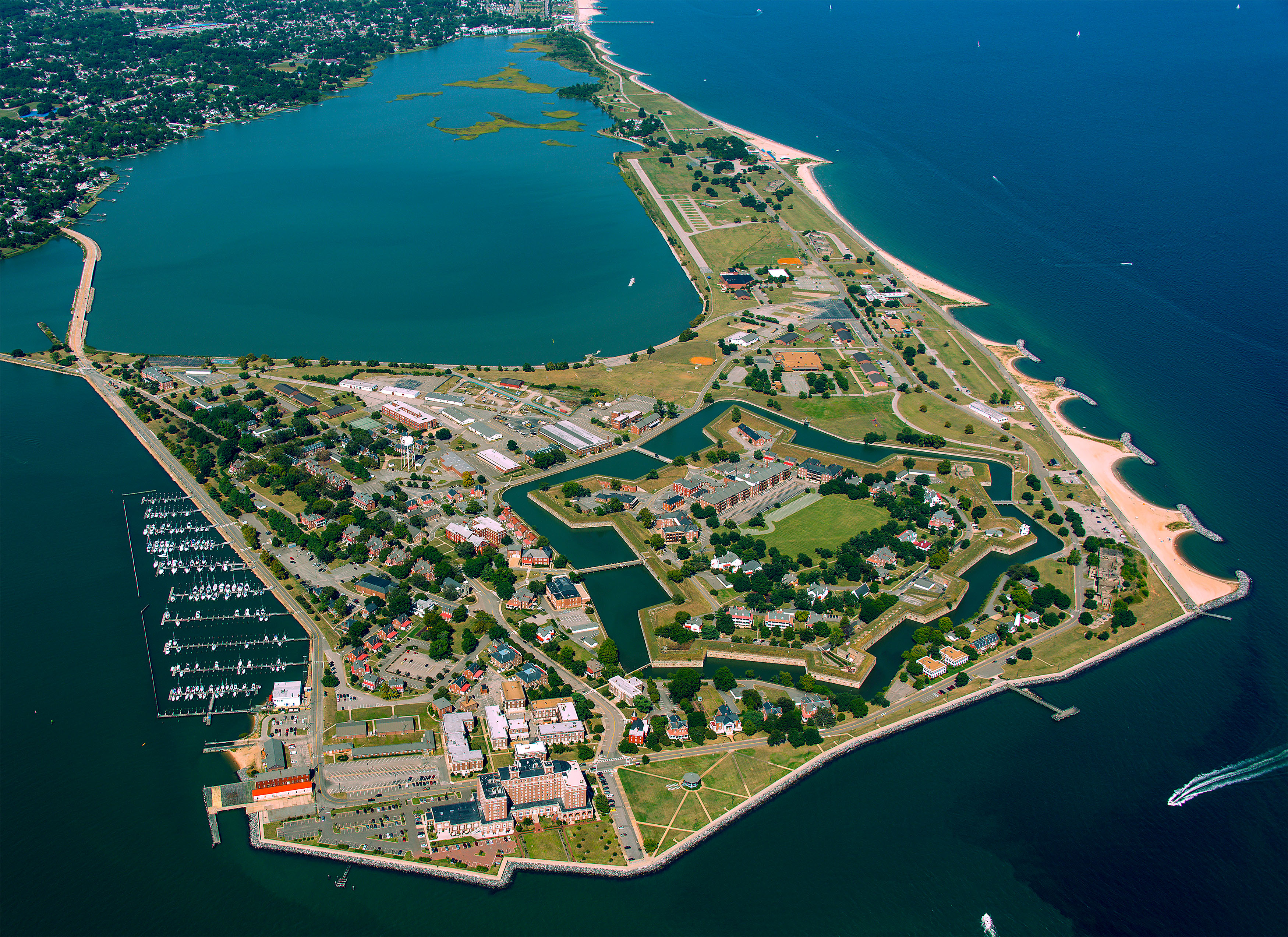
Hampton, Virginia — Old Point Comfort, where the Chesapeake Bay meets Hampton Roads.
There is something unsettling about a fortress that has outlived the wars it was built to fight. Its walls stand ready. Its cannon positions face the water. Its moat still draws a boundary between the world outside and the stories within. At Fort Monroe, those stories include shadowy sentries, a mysterious woman in white, and a Confederate president who spent two years behind stone walls.
But the most extraordinary thing about this place is not a ghost. It is that a fortress built partly through enslaved labor became a gateway to freedom for thousands.

The Ground Before the Fortress
Long before the star-shaped walls rose, the peninsula was part of the homeland of Indigenous peoples of the Chesapeake region. In 1607 English colonists recorded the place as Point Comfort. In 1619, a ship brought captive Africans to this area of English Virginia, a moment whose meaning would echo through centuries of enslavement and resistance.
Those facts are not background scenery. They are the foundation of the place. A haunting story about Fort Monroe cannot responsibly begin in 1834, as if the ground had no history until stone was laid upon it.
A Fortress Built to Keep Enemies Out
Following the War of 1812, the United States strengthened coastal defenses. Work on Fort Monroe began in 1819; the massive masonry fort was completed in 1834. French-born military engineer Simon Bernard helped design it. Enslaved workers were among those whose labor built the fort.
Its thick walls and casemates—arched, fortified chambers—were engineered for artillery and protection. The surrounding moat gave the complex the appearance of a European castle transplanted to the Virginia coast. Over time, casemates served not only military purposes but also as homes, offices, a prison and a museum.
Imagine the place before electric lighting: lanterns illuminating brick arches, boots striking stone, the sound of water beyond the walls. The scene is a historical reconstruction of atmosphere, not an eyewitness account of a haunting.
The Night Three Men Changed History
In May 1861, three enslaved men escaped forced labor supporting Confederate defenses and sought protection at the Union-held fort. They are commonly identified as Frank Baker, Shepard Mallory and James Townsend, though the National Park Service notes that surviving documentation of their names is not definitive.
Confederate authorities demanded their return. General Benjamin Butler refused. Using the Confederacy’s claim that enslaved people were property against it, he classified the men as “contraband of war.” It was an improvised legal argument, not a declaration of full equality. But the three men’s decision to flee forced the issue onto the national stage.
Others followed. Families arrived seeking safety. Their lives inside and near Union lines could still involve deprivation, uncertain legal status, unequal treatment and inadequate pay. Nevertheless, the act of leaving enslavement and claiming refuge helped shift the course of the war. Fort Monroe became known as Freedom’s Fortress.
The Camp Beyond the Walls
As more freedom seekers arrived, the fort could not accommodate everyone. Nearby camps and communities grew, including the Grand Contraband Camp in the Hampton area. The people who came were not merely passive recipients of protection. They organized households, worked, learned, taught and demanded a future different from the one they had escaped.
One remarkable figure was Mary Smith Peake, a free Black educator who taught children and adults near Fort Monroe in 1861. Her work is associated with the Emancipation Oak, later a landmark on the campus of Hampton University. In 1863, the Emancipation Proclamation was read there.
Picture the contrast: on one side, a fortress built to resist attack; on the other, people gathering beneath a tree to learn letters that slavery had tried to keep from them. History seldom gives us a more haunting image than that.
The Prisoner in Casemate No. 2
After the Confederacy collapsed, Jefferson Davis was brought to Fort Monroe in May 1865. The former Confederate president was imprisoned there until May 1867. For the first months, he was held in Casemate No. 2. His confinement, treatment and health became subjects of public argument. His cell is now part of the site’s historical interpretation.
Later ghost stories place a gaunt figure at a window or describe an uneasy presence near the old prison quarters. Such accounts should be understood as folklore, not proof that Davis still walks the fort. The documentary record establishes the imprisonment; it does not establish an apparition.
There is a deeper irony in this location. The man who led a government formed to preserve slavery was held inside the very fortress where thousands had begun their journeys out of bondage. No supernatural embellishment is necessary to make that history extraordinary.
The Lady in White
Like many old military sites, Fort Monroe has a “Lady in White” legend. Versions tell of a woman seen near the ramparts or old quarters, sometimes linking her to a jealous officer and a tragic death. The details shift across retellings, and the specific murder-and-burial story in popular accounts lacks a reliable historical record sufficient to present it as fact.
Why does the image endure? A white dress stands out against dark stone. A figure moving silently along a wall becomes a ready-made mystery. The tale also reflects a tendency in ghost folklore to reduce women’s complicated lives to tragedy, jealousy and loss.
The National Park Service’s historical material gives a fuller picture of women at Fort Monroe: wives, servants, laundresses and workers who made a military installation into a functioning community. Their real experiences deserve more attention than an invented crime presented as history.
The Footsteps That Follow
Other tales describe phantom marching, lanterns in abandoned spaces, and footsteps heard where no one appears. Some storytellers place these encounters in the casemates or passages beneath the walls. But Fort Monroe’s arches and enclosed chambers are also ideal places for sound to travel strangely. Echoes, moving air and the rhythms of a historic structure can create an unnerving experience without requiring a ghost.
That does not make the stories worthless. Folklore reveals how people experience a place. A soldier hears marching because the site is associated with soldiers. A visitor sees a figure in nineteenth-century clothing because the architecture makes the past feel near. The landscape gives the imagination a uniform to wear.
Accounts of screaming prisoners or secret underground deaths should not be repeated as established events without names, records and dates. Fort Monroe’s documented military and prison history is substantial enough to stand on its own.
The Fortress That Became a Neighborhood
Fort Monroe remained an active military installation through the nineteenth and twentieth centuries. Coastal artillery gave way to new technologies and new missions. The site included homes, workplaces, roads and familiar routines. Generations of service members and families lived inside the walls, so its memory is not exclusively a Civil War memory.
The Army deactivated the installation in 2011. That same year, Fort Monroe National Monument was established. Today the peninsula is a place of preservation, education and public life rather than an abandoned fortress. The Casemate Museum and surrounding historic landscape help visitors encounter its layered history.
For a future virtual tour, that distinction matters. We should show readers the actual surviving buildings and clearly mark any restricted areas, rather than implying that every atmospheric corridor is open to exploration.
What the Walls Remember
As evening settles over Hampton Roads, imagine looking across the moat toward the fort. The water darkens. The arched entrances become silhouettes. Somewhere beyond them, a visitor might expect to hear a guard call out from another century.
But listen more carefully to what history has already told us: three men arriving to demand refuge; families making lives in the shadow of war; a teacher gathering students beneath an oak; a defeated Confederate leader locked behind walls; generations of workers keeping the place alive.
The stories of phantom soldiers and a woman in white may continue to circulate. Whether anything supernatural walks the ramparts remains unproven. The fortress’s documented past, however, is neither silent nor settled.
At Fort Monroe, the most powerful ghosts may be the histories America once tried not to see.
Sources and Editorial Notes
National Park Service — History and Culture; National Park Service — Freedom’s Fortress; Fort Monroe Authority — History; 2011 Presidential Proclamation; City of Hampton — Fort Monroe History.
Editorial note: The fort’s dates, freedom seekers, educational history and Davis imprisonment are documented. The Lady in White, phantom guards and supernatural encounters are presented as folklore, not verified events. Atmospheric scenes are literary reconstructions.
✦ Wicked Grim Stories — The past whispers, but it does not confess.
Leave a Reply