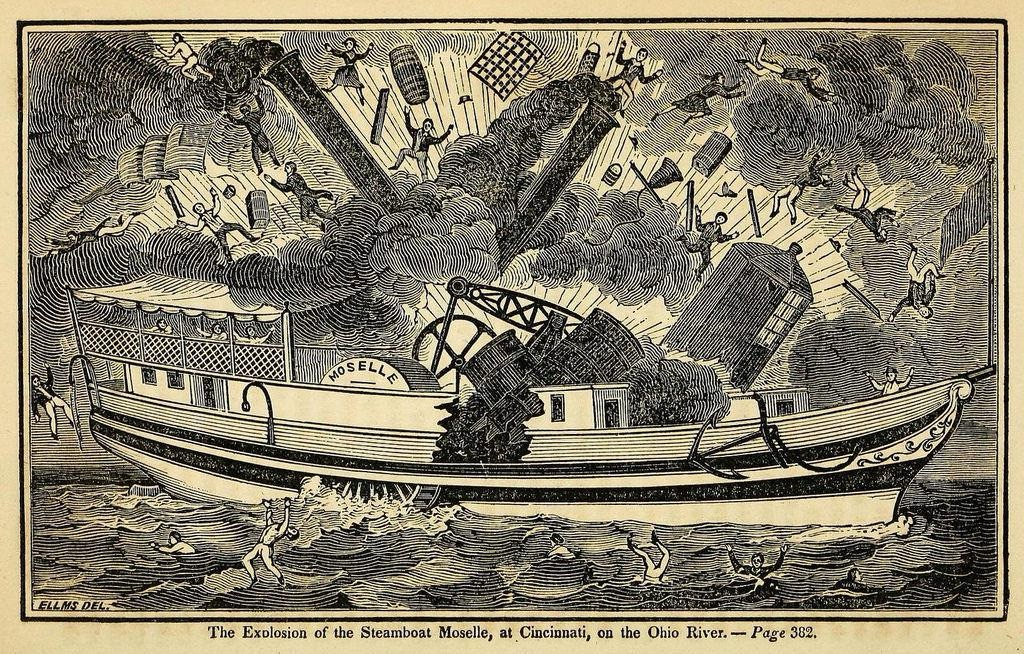
Fulton, near Cincinnati, Ohio — April 25, 1838. The river carried the wreckage downstream. It did not carry every name home.
The Blue Stitch
On the morning of April 25, 1838, Ruth Bellamy finished sewing a small blue star into the lining of a traveling coat. She was nineteen, careful with a needle, and certain that every garment ought to carry a name somewhere a stranger could find it.
“It’s a superstition,” her employer said.
“It’s a kindness,” Ruth answered.
Her customer, a woman traveling west, had given only the initials E.M. and paid in advance. She had promised to collect the coat before boarding a steamboat called the Moselle.
But when the woman arrived, she took one look at the finished coat and went pale.
“You stitched the name inside?”
“As requested.”
“I never told you my name.”
The Sound Across the Water
That evening, the Moselle departed Cincinnati and stopped near Fulton to take on passengers. In the documented disaster that followed, its four boilers exploded. The vessel was shattered, and many passengers and crew died. Historical estimates of the death toll vary, in part because passenger records were incomplete.
Ruth heard the blast from the sewing room. The window rattled. A spool of blue thread rolled off the table and came to rest against her shoe.
By the time she reached the river, people were pulling survivors from the water. Families called names into the darkness. Some names were answered. Others vanished beneath the noise.
The next morning, the traveling coat appeared on Ruth’s doorstep, wet but strangely undamaged. The blue star inside its lining had come undone.
And the initials E.M. had been replaced by a full name Ruth had never sewn.
A Name Without a Passenger
Ruth searched the newspaper lists of the dead and missing. The name in the lining appeared nowhere. She went to the river landing, where a clerk tried to help her reconcile the passenger accounts.
“People boarded without leaving their names,” he said. “Others were counted twice. There are families we cannot even tell whom to mourn.”
Ruth laid the coat on his desk.
He touched the embroidered letters and withdrew his hand.
“I saw this coat before,” he whispered. “On a woman who never boarded.”
“Then whose name is that?”
He looked toward the window, where the Ohio River moved steadily past the landing.
“That,” he said, “is what troubles me.”
The River’s Answer
For weeks Ruth returned to the landing with her notebook. She recorded names from families, scraps of letters, and the memories of survivors. She could not restore every missing identity. But she refused to let the unknown remain merely a number.
One night, the blue thread in her sewing basket tightened around her finger. When she pulled it free, it led to the traveling coat hanging by the door.
The lining was open. Beneath the first embroidered name was another.
Then another.
Ruth watched as the blue stitches seemed to gather into letters she had never learned to make. At last the thread went still. Inside the coat were seven names.
She copied them carefully. The following morning, she carried the notebook to the landing.
Whether the names belonged to real passengers, she never discovered. But she left the coat hanging in her window for the rest of her life, a blue star facing the river.
Years afterward, when Ruth’s shop was emptied, the coat was found in its usual place. The lining was blank.
Only one sentence remained, stitched where the heart would rest:
Tell them we were here.
The History Beneath the Fiction
The explosion of the steamboat Moselle near Fulton on April 25, 1838, is a documented event. Estimates of the number killed vary. Ruth Bellamy, the coat, the embroidered names, and the supernatural details are fictional. The story honors the difficulty of identifying all those who died, without claiming any particular ghost encounter occurred.
Historical background: Ohio History Connection — The Steamboat Moselle Disaster; Ohio Memory — Moselle engravings and broadsides.
Support the Author: If this story stayed with you, please share it and help keep forgotten history in the light.
Leave a Reply