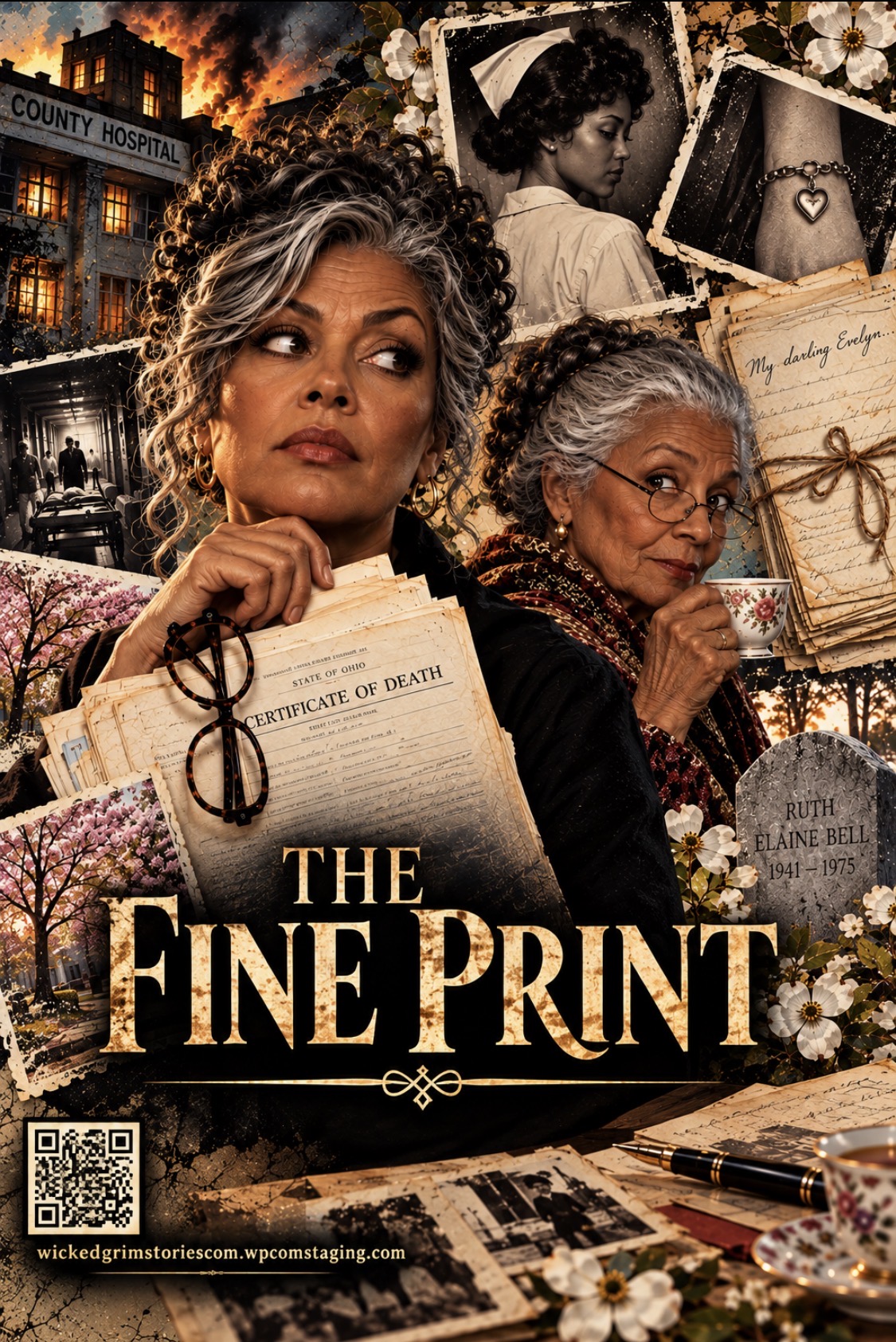
WICKED GRIM STORIES · EPISODE TWENTY
The Rain Check for One Hour
By Esi Noire
In February 1978, a grocery store in southern Ohio began issuing rain checks for something it did not sell.
Every slip promised the same thing.
ONE HOUR.
No price appeared beside it.
No expiration date.
No manufacturer’s name.
By May, sixty-one rain checks had been issued.
Sixty had been marked redeemed.
The sixty-first remained in the store’s records for forty-eight years, stamped in red ink:
NOT ELIGIBLE.
The store closed in 1991.
The owner died in 2004.
And the woman whose name appeared on that final rain check never spoke publicly about what happened.
Then, in October 2026, an old metal cash box arrived at the Bellwether Historical Society.
Inside were sixty-one carbon copies, a handwritten ledger, and a letter instructing whoever found them not to confuse a good idea with a fair one.
Mara Wynn had inherited three things from her grandmother Alma.
A silver bracelet.
A recipe for peach cobbler that required an unreasonable amount of butter.
And the belief that her grandmother had been the most generous woman in Bellwether.
The first two were easy to verify.
The third had become complicated.
Mara was forty-six and worked as a county records specialist. She had volunteered to help the historical society organize materials from several recently closed businesses.
When the cash box arrived, she recognized the faded label immediately.
WYNN’S MARKET — OFFICE.
Her grandmother’s grocery store had occupied the corner of Maple and Third for nearly thirty years.
People remembered the penny candy, the wooden produce bins, and Alma’s habit of giving children a stern lecture before slipping an extra cookie into their bags.
They also remembered her husband, Walter, who could calculate sales tax without a pencil but couldn’t remember a wedding anniversary to save his life.
Mara opened the cash box expecting receipts.
She found them.
But they weren’t for groceries.
The first read:
Rain Check No. 001 — One Hour.
Issued to: Mrs. Lillian Carter.
Purpose: Walkway clearing.
Redeemed: February 3, 1978.
The next was for carrying coal.
The third was for watching two children.
The fourth was for delivering groceries.
Mara turned to the historical society’s director.
“Apparently, Grandma sold time.”
The director looked at the slips.
“Was she successful?”
“Sixty people seem to think so.”
“What about the sixty-first?”
Mara studied the red stamp.
“I don’t know.”
The idea began after the great Ohio blizzard of January 1978.
Bellwether had been buried beneath snow and ice.
Roads closed.
Businesses shut down.
Families lost electricity.
Some residents stayed with relatives.
Others waited in cold houses for someone to clear a path or bring supplies.
Wynn’s Market reopened as soon as Walter could get the front door unstuck.
He claimed the snow had frozen it.
Alma claimed he had forgotten to unlock the second bolt.
Their marriage survived the disagreement.
The market became a gathering place for people exchanging information about who needed help.
Mrs. Carter needed her walkway cleared.
Mr. Foster needed someone to pick up his medicine.
A young mother needed someone to watch her children while she worked a short shift at the hospital.
People offered to help.
But offers were difficult to organize.
One person promised to shovel a sidewalk and forgot.
Another delivered groceries to a household that had already received three bags.
A man spent two hours fixing a neighbor’s furnace and later discovered the neighbor had promised to pay him in canned peaches.
He did not like peaches.
Alma decided the neighborhood needed a system.
She used the store’s rain-check pads.
Normally, a rain check promised a customer the opportunity to buy an advertised item later when it returned to stock.
Alma changed the meaning.
Anyone who volunteered an hour of help could earn a rain check.
Anyone who needed an hour of help could redeem one.
The service did not require money.
People could shovel snow, carry groceries, watch children, read letters, repair small household items, or provide transportation.
Alma kept a ledger of hours contributed and hours received.
She called it the Hour Exchange.
Walter called it a bookkeeping nightmare.
Both were correct.
The program began with eleven neighbors.
By March, thirty-four people had participated.
By April, sixty-one rain checks had been issued.
The grocery store became a place where people could ask for assistance without explaining their finances to a stranger.
At least, that was the idea.
Mara found the ledger beneath the carbon copies.
Every entry had a name, date, service, and signature.
Some people gave more hours than they received.
Others received help before they could contribute.
Alma allowed both.
There were small disagreements.
One man insisted that repairing a bicycle should count as two hours because he had spent forty minutes locating his tools.
Alma informed him that looking for his tools was not a public service.
A woman complained that the person sent to clean her kitchen had rearranged the spice cabinet.
The volunteer replied that she had found cinnamon beside the furniture polish and considered intervention necessary.
The ledger recorded both complaints.
Mara smiled.
She could hear her grandmother’s voice in the notes.
But near the end, the handwriting changed.
The entries became shorter.
Several pages contained corrections.
Then came the final rain check.
No. 061.
Issued to Ruth Bellamy.
Purpose: Transportation.
Date requested: April 21, 1978.
Beside it was a notation:
Denied — paid employee.
Underneath, in different handwriting:
Fourteen hours contributed.
Mara read it again.
Fourteen hours.
One hour requested.
Denied.
She called her mother, Denise.
“Do you remember Ruth Bellamy?”
“Of course.”
“Was she a cashier at the market?”
“She cleaned the store in the evenings. Sometimes she helped Grandma with inventory.”
“Did Grandma like her?”
“Very much.”
“Then why would Grandma refuse to give her a rain check?”
Denise went quiet.
“What rain check?”
Mara explained.
Her mother listened without interrupting.
Finally, she said, “I remember them having an argument.”
“Grandma and Ruth?”
“Yes.”
“About what?”
“I was sixteen. Adults didn’t explain everything to sixteen-year-olds, especially when they knew we would repeat it to everybody at school.”
“Did Ruth quit?”
“No. She worked there until the store closed.”
“Then they made up?”
Denise hesitated.
“Working together isn’t always the same as making up.”
Ruth Bellamy had died in 2011.
Her daughter, Patrice, lived in Cincinnati.
Mara found her through an old church directory and sent a letter explaining the historical society’s project.
Patrice called three days later.
“I know about those rain checks,” she said.
“Your mother told you?”
“She told everybody who would listen.”
Mara sat up straighter.
“Then why hasn’t anyone mentioned it?”
“Because most people remember the good part.”
Patrice agreed to meet her.
They chose a small restaurant halfway between Bellwether and Cincinnati.
Patrice arrived carrying a folder.
She was seventy-two, neatly dressed, and spoke with the calm precision of someone who had spent many years correcting people who were certain they were right.
“My mother worked at Wynn’s Market,” she began. “But she also helped half that neighborhood.”
Mara opened the ledger.
“I found fourteen hours listed.”
Patrice nodded.
“She watched children. Delivered groceries. Read letters for people who had trouble seeing. Helped an older man organize his medicine bottles. None of that was part of her job.”
“Then why was she denied?”
Patrice opened her folder.
“Because somebody decided that being paid for one kind of work meant she couldn’t ask for help with another.”
On April 21, 1978, Ruth needed a ride to the hospital.
Her mother was being discharged after a short stay.
Ruth did not own a car.
She had arranged for a neighbor to drive her, but the neighbor canceled that morning.
Ruth went to Wynn’s Market and asked to redeem one of her hours.
The clerk checked the ledger.
Then she called Alma.
Alma was out making a delivery.
Walter came from the storeroom.
He looked at Ruth’s entry.
Then he told her she was not eligible.
The Hour Exchange, he explained, was intended for neighborhood volunteers.
Ruth was an employee.
She already received wages.
Ruth pointed out that she had contributed fourteen hours outside her paid work.
Walter replied that the ledger had mistakenly counted some of those hours.
He said the rules needed clarification.
Ruth asked whether her mother could wait at the hospital while the rules were clarified.
Walter did not appreciate the question.
He stamped the rain check.
NOT ELIGIBLE.
Ruth left.
She paid for a taxi.
The fare cost nearly what she earned during a shift at the market.
She missed work the following morning because her mother’s discharge had been delayed.
The lost wages hurt more than the taxi fare.
But neither was what Ruth remembered most.
“She was embarrassed,” Patrice said.
“Because she needed help?”
“Because she’d helped other people and then had to stand at the counter explaining why she deserved the same consideration.”
Mara looked at the ledger.
“Did Grandma know?”
“She found out that afternoon.”
“What did she do?”
“She offered my mother money.”
“Did Ruth take it?”
“No.”
“Why?”
Patrice leaned forward.
“Because she wasn’t asking for charity. She was asking them to honor their own rules.”
That distinction stayed with Mara.
Her grandmother had always been generous.
But generosity was not the same thing as fairness.
Generosity depended on what the giver wanted to offer.
Fairness required a promise to apply even when the person asking made someone uncomfortable.
Mara returned to the historical society and examined the remaining documents.
The Hour Exchange had ended in May 1978.
The final page of the ledger contained a note:
Program suspended pending review.
There was no explanation.
Mara searched old newspapers.
She found a brief announcement in the Bellwether Gazette.
Wynn’s Market Ends Volunteer Exchange.
The article praised the program for helping residents recover from the winter storm.
It said the exchange had completed sixty hours of service.
It thanked Alma and Walter for their community spirit.
It did not mention Ruth.
The article ended with a quotation from Walter:
“We are proud of what our neighbors accomplished together.”
Mara stared at the sentence.
Sixty hours.
Not sixty-one.
The record had been cleaned up.
She visited the former grocery store.
It was now a small appliance repair business.
The owner allowed her to examine the old storeroom.
Most of the original fixtures were gone.
The wooden shelves had been replaced.
The cash register had disappeared.
But the back wall still contained a narrow built-in cabinet.
Mara remembered her grandmother keeping account books there.
The cabinet was empty except for a loose piece of cardboard.
On the cardboard, someone had written:
Ruth — see separate file.
Mara photographed it.
Then she called Patrice.
“Did your mother ever file a complaint?”
Patrice laughed softly.
“My mother didn’t believe in letting a complaint die of loneliness. She kept writing until somebody answered.”
The separate file was not in the grocery store.
It was in the county’s donated business records.
Mara found it three days later.
The folder was thin.
Inside was a letter Ruth had written to Alma.
It was dated April 25, 1978.
Dear Mrs. Wynn,
I am not asking for the taxi fare.
I am asking why my hours were good enough to count when somebody else needed them, but not good enough when I did.
If you say this is an exchange, then it must be an exchange for everybody who participates.
Otherwise, it is only another way of asking certain people to give.
Respectfully,
Ruth Bellamy.
Mara read the letter twice.
Then she found Alma’s reply.
Alma had written back four days later.
She acknowledged that Ruth had contributed fourteen unpaid hours.
She admitted that Walter had applied a rule that had never been written down.
She offered to honor the rain check and reimburse Ruth for the taxi.
But she also explained that several volunteers had objected to counting hours contributed by paid employees.
Some believed the exchange should be limited to households with no other assistance.
Others worried that the same people would always be asked to give more than they received.
Alma had called a meeting.
The members could not agree on how the program should continue.
So she suspended it.
Her letter ended:
I thought I was making it easier for neighbors to help one another.
I did not consider how quickly we would begin deciding which neighbors deserved help.
You were right to ask.
Mara sat back.
She had expected to find an apology.
She had not expected to find the reason the program ended.
There was one more document.
It was a carbon copy of a memorandum addressed to the county records office.
The writer requested that the original ledger and Ruth’s letter be preserved together.
A handwritten note appeared in the lower corner:
R.E.C.
Below the initials:
Retain denied claim with original register. Do not substitute public summary.
Mara recognized the initials.
She had seen them before in unrelated historical collections.
A telephone-company dispute.
A neighborhood housing petition.
An old payroll investigation.
Different years.
Different offices.
The same three letters.
She took a photograph.
Then she returned the document to its folder.
For now, the Hour Exchange had a mystery of its own to settle.
Mara met Patrice again.
This time, she brought copies of Alma’s letter.
Patrice read it carefully.
“My mother kept the original.”
“Did she ever accept the apology?”
“She accepted that Mrs. Wynn had admitted she was wrong.”
“Isn’t that the same thing?”
“No.”
Patrice folded the copy.
“My mother liked Alma. She respected her. But she wanted the rule changed, not just an exception made for her.”
“Did it change?”
“Not in time to save the exchange.”
Mara looked disappointed.
Patrice noticed.
“You wanted a happier ending.”
“I suppose I did.”
“My mother had plenty of happy endings. She raised four children. Worked thirty years. Bought a little house. Laughed at terrible jokes. But that doesn’t mean every unfair thing that happened to her was corrected.”
Mara nodded.
Patrice smiled.
“She also told that story at family dinners for years. Walter Wynn was not popular at our table.”
The historical society had planned an exhibit about the blizzard of 1978.
Photographs showed buried cars, snowdrifts taller than children, and neighbors helping neighbors.
There were stories about people sharing generators, delivering food, and checking on elderly residents.
The Hour Exchange seemed like a perfect addition.
The director suggested displaying the ledger and a selection of redeemed rain checks.
Mara agreed.
Then she asked to include No. 061.
The director frowned.
“Won’t that spoil the story?”
Mara looked at him.
“What story?”
“The story about how the community came together.”
“It did come together.”
“Then why focus on the one thing that went wrong?”
“Because the sixty people who received help don’t disappear when we acknowledge the sixty-first person who didn’t.”
The director studied the rain check.
“That’s going to make the display more complicated.”
Mara smiled.
“History usually is.”
The exhibit opened in October.
Mara placed the rain checks in chronological order.
Beside them were photographs of the grocery store and the neighborhood after the blizzard.
A large panel explained how the Hour Exchange worked.
Visitors could read examples of the services people provided.
There was the woman who spent an hour teaching a neighbor to mend a coat.
The man who cleared three sidewalks.
The teenager who carried groceries to an elderly couple.
The mother who watched another woman’s children while she attended a job interview.
Then came the final rain check.
No. 061.
Ruth Bellamy.
One Hour.
NOT ELIGIBLE.
Beneath it, Mara displayed Ruth’s letter and Alma’s response, with Patrice’s permission.
The exhibit did not ask visitors to decide whether Alma had been a good person.
It asked them to consider what happened when a generous idea became a system with rules.
Patrice attended the opening.
So did Denise.
They stood together before the display.
Denise read Ruth’s letter.
Then she looked at Patrice.
“I remember your mother.”
“She remembered your mother too.”
“I’m sorry about what happened.”
Patrice nodded.
“Thank you.”
Denise looked toward the photograph of Alma.
“She would have hated having her mistake on display.”
“Probably,” Patrice said.
Then she smiled.
“But she kept the letter.”
That was true.
Alma could have destroyed the complaint.
She could have removed the denied rain check.
She could have allowed the newspaper’s cheerful account to become the only surviving version.
Instead, she preserved the record.
Not because it made her look good.
Because it was true.
Near the end of the evening, a visitor approached Mara.
He was an older man wearing a brown coat.
“I remember that program,” he said.
“Were you a participant?”
“My mother was.”
“Did she receive help?”
“She got somebody to fix her porch steps.”
He studied the display.
“I didn’t know about the woman who was turned away.”
“Most people didn’t.”
He looked at Ruth’s letter.
“Seems like somebody should have helped her.”
Mara nodded.
“Yes.”
The man stood quietly.
Then he said, “My mother always said Mrs. Wynn was a good woman.”
“She may have been.”
“Does this change that?”
Mara thought about her grandmother.
The extra cookies.
The grocery bags left on doorsteps.
The arguments with Walter.
The letter she had written when Ruth challenged her.
“I think it makes the story more complete.”
After the visitors left, Mara returned to the cash box.
She had one final task.
The sixty redeemed rain checks were being placed in archival sleeves.
The sixty-first would be stored with Ruth’s letter and Alma’s reply.
She examined the back of the original slip.
Until then, she had only looked at the front.
There was a faint pencil mark near the bottom.
She tilted it toward the light.
Four words appeared.
Still owed one hour.
The handwriting was Alma’s.
Mara sat down.
Her grandmother had never crossed out the debt.
She had never marked it settled.
She had offered money.
She had offered an apology.
But she had left the rain check open.
Perhaps because Ruth never received the help she had asked for.
Perhaps because Alma finally understood that some promises could not be repaired after the moment had passed.
Mara placed the slip in its sleeve.
The following morning, she called Patrice.
She told her about the pencil note.
Patrice was silent for a moment.
Then she laughed.
“That sounds like Mrs. Wynn.”
“Why?”
“Because my mother would never have let her forget it.”
They spoke for a while about their families.
About the blizzard.
About the grocery store.
About the strange things people remembered and the important things they managed to forget.
Before they ended the call, Patrice said something Mara wrote down.
“My mother didn’t want everybody to stop helping one another. She wanted them to stop keeping two sets of rules.”
Mara looked at the rain check on her desk.
Sixty people had received an hour of someone’s time.
One woman had been denied.
Both facts belonged in the history.
The exhibit remained open through November.
Visitors stopped to read the letters.
Some remembered the grocery store.
Some remembered the blizzard.
Others recognized the familiar problem of people who were always expected to help but rarely encouraged to ask for help themselves.
A few suggested restarting the Hour Exchange.
Mara liked the idea.
But she insisted that any new program would need written rules, a clear way to handle complaints, and a way to make sure the people giving their time could receive help too.
The director said that sounded like a great deal of paperwork.
Mara looked at him.
“Funny how paperwork becomes important when you’re the one who might need the promise kept.”
He conceded the point.
Reluctantly.
At the end of the exhibit, Mara added one sentence beneath the photograph of her grandmother.
The Hour Exchange helped many families after the winter of 1978. Its records also preserve the account of one participant whose request was denied, and whose challenge changed how the program was remembered.
She stood back.
It wasn’t a perfect tribute.
It wasn’t meant to be.
Alma Wynn had been generous, stubborn, imaginative, and sometimes wrong.
Ruth Bellamy had been hardworking, proud, and unwilling to let an unfair rule pass quietly.
Neither woman needed to be turned into a saint for her story to matter.
The little rain check had outlived them both.
It had survived a store closing, a forgotten cash box, and nearly half a century of silence.
And in the end, it still carried the same promise.
ONE HOUR.
No price.
No expiration date.
No proof that the debt had ever been paid.
Only a reminder that time given freely was still worth something.
Especially to the person who had been told hers did not count.
Leave a Reply