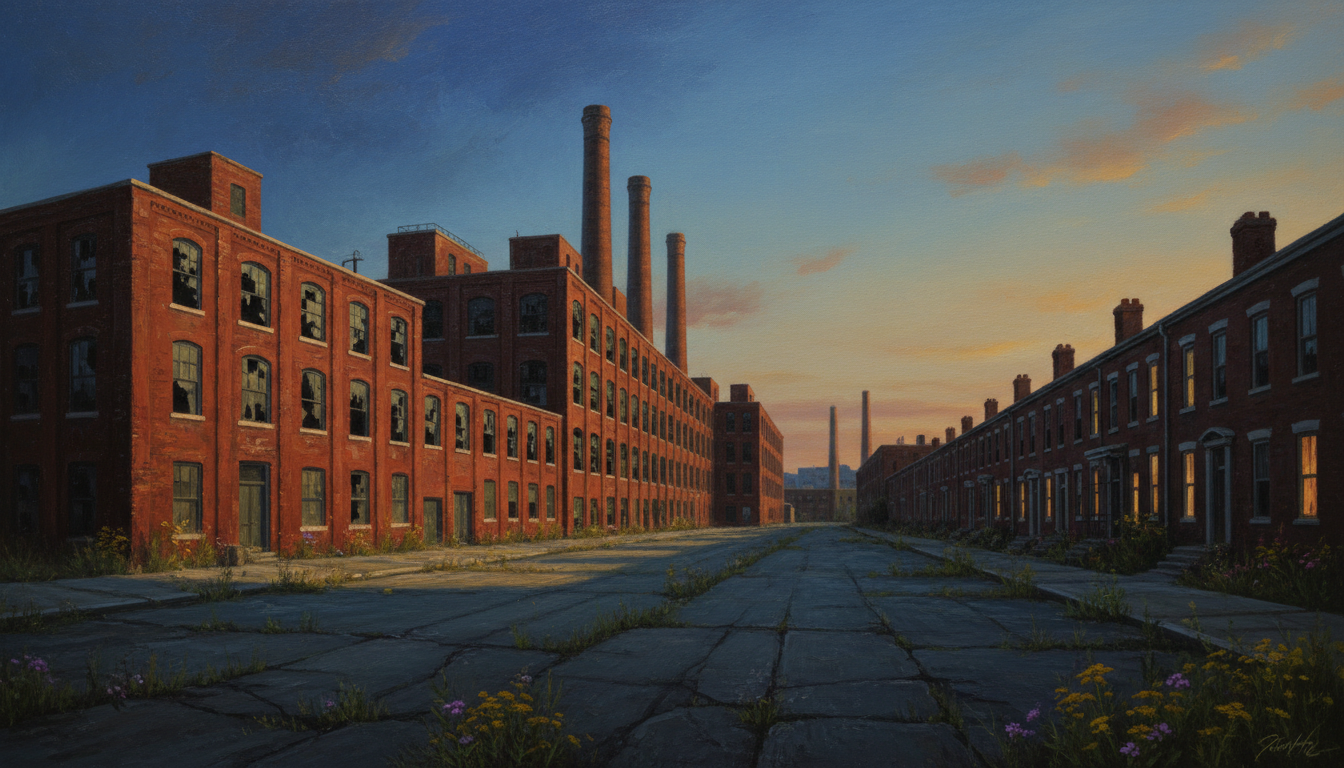
Ohio, Indiana, and the industrial Midwest — places where the factories changed, but the memories stayed.
There is a particular kind of quiet that settles around an old factory. The building may still stand, but the shift whistle no longer calls anyone to work. A parking lot that once filled before sunrise grows weeds through its cracks.
People call these places forgotten towns. But the people who still live there haven’t forgotten a thing.
Youngstown, Ohio: Black Monday
On September 19, 1977, Youngstown Sheet and Tube announced major closures at its Campbell Works. The day became known as Black Monday. Thousands of steelworkers faced the loss of jobs that had supported families for generations. More mill closures followed in the Mahoning Valley.
Imagine the sound that mattered most that week: not a ghostly whistle, but a family sitting at a kitchen table trying to decide what came next.
There is no need to invent a phantom shift change. The real loss was immense enough.
Springfield, Ohio: Buildings That Remember
Springfield’s industrial history lives in its streets, old commercial buildings, schools, and neighborhoods. Some buildings have been reused; others have deteriorated or disappeared. An empty school can be eerie, especially if you imagine the children who once hurried through its halls.
But the story of an unseen pianist playing in a ruined classroom, sometimes repeated in spooky retellings, is not one I can verify. Here, the haunting is a literary image: the distance between a place’s former purpose and its present silence.
Gary, Indiana: Built Around Steel
U.S. Steel founded Gary in 1906 as an industrial city. Steel employment helped shape its growth, while decades of industrial restructuring and population loss transformed whole neighborhoods.
Gary’s empty landmarks have attracted photographers and ghost-story enthusiasts, but photographs of ruined buildings tell only part of the truth. Families, churches, businesses, and community organizations have continued their lives there. A city is not an abandoned movie set simply because some of its buildings are vacant.
Dayton, Ohio: After the Last Shift
Dayton’s story includes invention, manufacturing, and painful industrial transitions. The last vehicle rolled off the General Motors Moraine assembly line in December 2008. In 2009, NCR announced its departure from Dayton. Those decisions changed the region’s economy and affected the lives of workers and their families.
Stand near an old industrial site and it is easy to imagine a worker in coveralls turning a corner. That is an imagined scene, not a documented apparition. The real workers were people with mortgages, children, routines, and plans that did not end neatly when a plant closed.
Dayton’s Memorial Day Tornadoes: When the Landmarks Fell
Economic losses were not the only blows to the Miami Valley. On Memorial Day night in 2019, a devastating tornado outbreak tore through the Dayton region, damaging homes, businesses, and neighborhoods already facing difficult challenges. Ohio’s disaster recovery plan recorded nearly 6,000 damaged homes and almost 400 damaged commercial and industrial businesses across the affected region.
Hara Arena, the landmark on Shiloh Springs Road spanning Trotwood and Harrison Township, had already closed in 2016. For decades it hosted concerts, sports, trade shows, and the Dayton Hamvention. The 2019 tornadoes ripped apart much of the closed complex. Attempts to save it did not succeed, and demolition began in 2020. A place that held so many memories was physically gone.
That loss tells us something an empty factory alone cannot: communities can be struck by several kinds of upheaval at once. When jobs disappear, buildings age, and then a tornado destroys homes and landmarks, rebuilding is not just a matter of replacing walls. It means restoring the routines, gathering places, and sense of security people once relied upon.
In January 2026, local reporting said Ohio had acquired the former Hara Arena property for a planned behavioral health hospital. Even that new chapter cannot erase what residents remember of the old arena.
Where the Houses Used to Be
One Dayton-area resident remembers what came after the tornadoes as vividly as the storms themselves. So many damaged houses were demolished that some streets were left with nothing but grass-covered plots. Drive past today, and you might never guess that a family once lived there. A kitchen, a front door, a lifetime of ordinary moments—all gone from the landscape.
The destruction could look almost impossible to explain. Apartments and businesses were leveled, yet some daycare buildings stood amid the wreckage. Tornadoes can leave sharply uneven patterns of damage. To those who witnessed it, the contrast was eerie.
Power was out for a week or longer in parts of the community. The experience was mentally exhausting, especially when daily routines disappeared along with electricity and familiar landmarks. Grocers and food pantries distributed water while residents tried to manage each day.
What the Storms Could Not Take
And then people came.
Churches, mosques, synagogues, people with no religious affiliation, teenagers from outside the neighborhoods, and individual families arrived with food. Some brought sandwiches. Others brought whole meals. People from different economic backgrounds helped without sorting neighbors into poor, middle class, or wealthy. They saw people who were hungry, tired, frightened, and in need—and they fed them.
That generosity did not undo the damage. It did something else: it reminded survivors that they had not been abandoned. The memory of empty lots sits beside the memory of strangers handing out meals. Both belong in Dayton’s history.
Sometimes the most enduring thing left standing after a disaster isn’t a building. It’s the community.
What Really Haunts a Place?
It isn’t always a ghost. Sometimes it is the outline of a sign removed from a brick wall. A boarded storefront beside an occupied home. A street where an older resident can point to each empty lot and tell you whose family once lived there.
The Rust Belt’s story isn’t a simple tale of prosperity followed by death. There were labor struggles, migration, segregation, business decisions, global competition, and generations of reinvention. People still build lives in these communities, even as they live with the consequences of what was lost.
Maybe that is what makes the old buildings unsettling. They remind us that something can be essential to thousands of lives and still be allowed to disappear.
The factories may have gone quiet. The people never stopped having stories.
Historical Notes
Youngstown’s 1977 Campbell Works closure is documented by the Mahoning Valley Historical Society and contemporary reporting. Gary’s founding and industrial history are documented by the Federal Reserve Bank of Chicago and regional planning records. Dayton’s GM Moraine closure and NCR departure are documented in Dayton Daily News reporting. The 2019 tornado impacts are documented in Ohio’s CDBG-DR Action Plan; Hara Arena’s closure, storm damage and demolition were reported by WYSO, WHIO and ARRL, and the proposed new hospital site was reported by WHIO in January 2026. Descriptions of empty lots, uneven damage, extended power outages and neighbors bringing meals and water are based on a Dayton-area resident’s firsthand recollections. The ghostly imagery in this article is atmospheric writing, not a claim of verified supernatural events.
Leave a Reply