From Maryland to the hills of West Virginia, the old railroad still has stories to tell.
A whistle sounds different after dark. It travels through a valley, bends around a hillside and seems to come from somewhere beyond sight. For generations, that sound meant arrivals, departures, work and sometimes disaster. Along the old Baltimore & Ohio Railroad, it also became the raw material of ghost stories.
America’s Railroad Experiment
Chartered on February 28, 1827, the Baltimore & Ohio was the United States’ first common-carrier railroad. Its backers wanted to connect Baltimore to western commerce. The first stone was laid July 4, 1828, and service began between Baltimore and Ellicott’s Mills in 1830. Over time, its network reached into the Appalachian mountains and Midwest.
It changed the scale of daily life. Coal, manufactured goods, mail and passengers could travel farther and faster. But the new speed came with danger. Crews worked among heavy machinery, steep grades, tunnels and signals whose failure could be catastrophic.


Stone, Steam and the Road West
When the B&O began, the railroad was not yet the familiar landscape of iron locomotives and long strings of coaches. Some of its first cars were horse-drawn. Early track construction experimented with stone supports and iron-strapped rails. Its backers had to prove that a commercial railroad could connect the port of Baltimore with inland markets across difficult country.
On July 4, 1828, Charles Carroll of Carrollton, the last surviving signer of the Declaration of Independence, laid the ceremonial first stone. The symbolism was deliberate: the young republic was investing in a new way to move people and goods. Regular service to Ellicott’s Mills began in 1830, and the railroad finally reached the Ohio River at Wheeling in 1853—roughly a quarter-century after the first stone.
That long delay is part of the history too. The Appalachian mountains were not an empty backdrop. They presented grades, river crossings, rock cuts, construction costs and years of difficult labor. Behind every romantic picture of a steam locomotive was a network of people building and maintaining the route.
The Telegraph Beside the Tracks
Railroads did not simply change transportation. They helped change communication. On May 24, 1844, Samuel Morse’s famous message, “What hath God wrought,” traveled between Washington and Baltimore over telegraph wires following the B&O corridor. The same country that had struggled to move news at the speed of a horse was learning to send words nearly instantly.
For railway workers, communication would become essential to safety. Trains shared tracks, moved in opposite directions and depended on dispatching, signals and disciplined schedules. When those systems failed—or were misunderstood—the consequences could be devastating.
Railroad Workers, Not Just Railroad Legends
It is easy to romanticize a conductor’s lantern in the mist. The historical job behind that image was much less romantic. Brakemen, engineers, switchmen, track crews and telegraph operators performed dangerous work in every season. Before modern air brakes and other safeguards became widespread, men could be required to move across the tops of moving freight cars to operate hand brakes. Switching yards and coupling equipment carried risks of crushing injuries.
Not every worker left a diary or made the newspaper. Their stories are often preserved in accident reports, payrolls, labor records and the geography of railroad towns. That makes careful historical research especially important: invented ghost sightings should not replace the difficult lives of actual people.
Railroad Memory and the Underground Railroad
The B&O also occupied complicated ground in the years before the Civil War. Its routes linked Baltimore and Washington with places farther north and west. The B&O Railroad Museum examines the connection between its transportation network and the Underground Railroad, the much broader network through which enslaved people sought freedom. The two “railroads” were not the same institution, and the metaphor should not obscure the risks taken by freedom seekers and those who assisted them.
The line later became strategically important during the Civil War, when tracks, bridges and rolling stock could determine how quickly troops and supplies moved. To understand the B&O is to see both the promise of new technology and the conflicts of the society that built it.
The Night at Terra Cotta
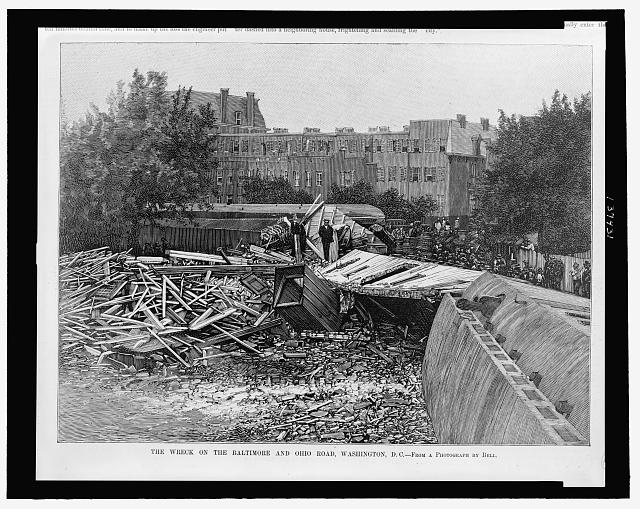
One tragedy in an earlier version of this article was misplaced in both time and geography. It was not a 1903 head-on collision near Silver Spring, Maryland. The documented catastrophe occurred on December 30, 1906, at Terra Cotta station in Washington, D.C.
That foggy evening, a B&O passenger train from Frederick was leaving the station when another train struck it from behind. The collision destroyed wooden passenger cars and killed dozens of people. Contemporary newspaper reports varied as rescuers worked and casualty counts changed; later histories commonly give 53 deaths.
The next morning’s newspapers described a terrible scene. Those pages deserve more weight than a modern claim that fiery phantom coaches still race down the line. I found no reliable evidence for the specific ghost-train sightings attributed to that wreck in the original draft.
What remains is a real place, a real loss and a warning about the dangers of rail travel in an age before modern safety systems.

The Tunnel with a Reputation
West Virginia offers a better-documented piece of railroad folklore. The North Bend Rail Trail follows a former B&O corridor across the state’s north-central hills. Its roughly 72 miles include old bridges and tunnels, including the Silver Run Tunnel, often identified locally as a haunted place.
The corridor grew from the Northwestern Virginia Railroad, constructed in the 1850s and later incorporated into the B&O system. Trains used the line for more than a century; the final train passed in 1985. Today, people travel the route on foot or bicycle instead of by locomotive.
Silver Run’s reputation survives in trail descriptions and local lore. Stories sometimes feature a spectral woman or strange lights near the tunnel. Their variations are part of folklore, not verified encounters. Even without a ghost, an old railroad tunnel can unsettle a visitor: daylight narrows to a distant opening, footsteps echo, and small noises seem unexpectedly large.
The Lantern Beyond the Curve
Railroad lanterns once had a practical purpose. Workers used lights and signals to communicate where visibility was poor. In the imagination, those same moving lights became the lanterns of brakemen still keeping watch after death.
An earlier version of this article included a hiker following a mysterious lantern until sunrise, a conductor seeing an impossible train and a transparent engineer waving from a locomotive. I could not trace those anecdotes to identifiable witnesses, dates or historical records. Rather than assign them to real railroad employees, they belong to the tradition of invented or unverified railway tales.
Imagine a lantern flickering beyond a bend on an abandoned right-of-way. The rails are gone. There is no train due. The light disappears as quickly as it came. It is an effective ghost-story scene precisely because it reverses the old rule of railroading: a signal should mean something.
This lantern scene is literary imagination, not a reported incident.
When a Railroad Leaves but Its Sound Remains
There is a reason these stories linger. Railroads shaped towns. Stations became meeting places. The timetable organized working lives. Then industries changed, routes closed, and the sounds that once filled the valleys fell silent.
A disused bridge or tunnel is not merely abandoned infrastructure. It is a reminder of people who built, maintained, rode and depended on a system that remade the country. Some of those people died in its service. Their histories should be remembered accurately, without inventing testimony in their names.
Perhaps the phantom train is a way of describing the absence itself: a familiar sound that the landscape seems to be waiting to hear again.
What the Tracks Can Tell Us
The B&O’s documented past offers more than enough drama: engineering ambition, economic transformation, dangerous labor, catastrophic accidents and entire communities connected by iron rails. The folklore adds atmosphere, but it should never replace the record.
If you walk the North Bend Rail Trail, visit during permitted hours, carry a light for the tunnels and remember that a historic corridor is a real landscape, not a movie set.
And if a distant sound resembles a whistle, you need not decide immediately whether it came from a train, the wind or your imagination. Sometimes the past is most powerful when we know exactly what happened—and recognize what we cannot prove.
✦ Wicked Grim Stories — The past whispers, but it does not confess.
Sources and Editorial Note
Library of Congress — B&O founding; B&O Railroad Historical Society; Morning Oregonian, December 31, 1906 — contemporary Terra Cotta disaster report; Washington Post — retrospective on Terra Cotta; West Virginia State Parks — North Bend Rail Trail; North Bend Rails-to-Trails Foundation.
Editorial note: The specific phantom-train and worker eyewitness accounts in the earlier draft could not be independently verified. This feature distinguishes documented accidents from folklore and explicitly imagined scenes.
Leave a Reply