Ghostwriter: Elara Vale
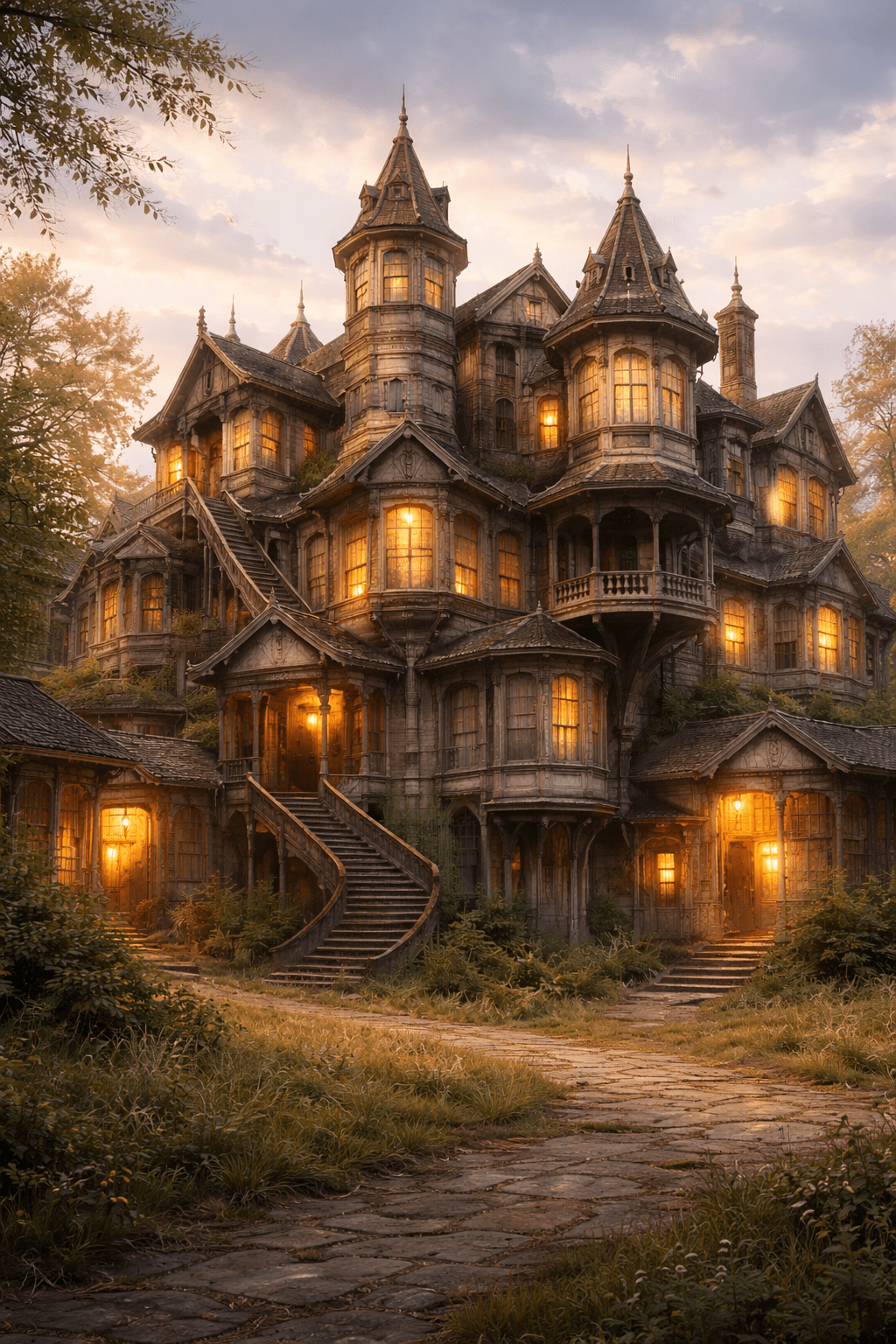
They say San Jose is a city of clean lines now—glass towers, data humming through the air like gnats you can’t swat. But the house still breathes. It squats behind hedges like a thought you tried to forget and failed. The Winchester Mystery House does not care that it’s 2026. It remembers 1884 the way a scar remembers the knife.
Picture this in a voice smooth as velvet draped over a coffin—yes, that voice, amused and grave at once.
Sarah Winchester knew a thing or two about ghosts. Not the white-sheet kind. I mean the kind that shows up as drafts in sealed rooms, as footsteps with no feet, as guilt that refuses to age out. Her money came from rifles that changed the grammar of death—made killing efficient, repeatable, scalable. The spirits followed the dividends west, polite at first, then hungry.
So she built.
She built the way some people pray and others drink.
A staircase that climbs bravely and ends in the ceiling. A door that opens onto a wall like a punchline with no joke. Windows in the floor. Hallways that corkscrew back into themselves. A house designed like a bad dream that keeps correcting itself mid-sentence.
The story they sell tourists is that the maze was meant to confuse the dead. That’s cute. That’s comforting. It suggests control.
Here’s the truer version: the house wasn’t to confuse the ghosts. It was to keep Sarah moving.
Every night at midnight she met with the dead—so the legend goes—and every morning she gave the carpenters new orders. Keep building. Don’t stop. Motion was the only thing keeping the past from sitting beside her on the bed and saying her name. Motion was the tax she paid to remain among the living.
The house learned this.
Buildings do that when you treat them like confessional booths for decades. They pick up habits. They develop opinions.
By the early 1900s, the house had a nervous system. You could feel it when the air changed temperature for no reason, when your phone lost signal in a place it shouldn’t, when your body took a wrong turn before your mind did. The architecture didn’t trap spirits—it processed them. Like a meat grinder for grief. Like an algorithm that never finished running.
People still wander through today with earbuds dangling, half-listening to guides crack jokes. They laugh at the stairs-to-nowhere, snap photos, post captions about “spooky vibes.” But the house listens to them too. It catalogs their fear responses. It learns which doors make people hesitate, which corridors make them speed up. Silicon Valley trained the world to believe that systems watch us quietly. This one was watching long before anyone called it smart.
At night, when the tours are done and the city exhales, the house replays old arguments. Nails hammer where no nails fall. A woman in black silk crosses a room and vanishes not because she’s a ghost, but because the room decides she’s finished.
Sarah is still there—not as a spirit, exactly, but as a process. A loop. An instruction set carved into wood and plaster: Never stop building. Never arrive.
The rifles made bodies fall. The house made time stumble.
And here’s the part no one puts on the brochure, delivered with a courteous smile and a raised eyebrow:
The maze worked.
The dead are still wandering those halls, distracted, misdirected, eternally one turn away from resolution. But so are we. We just call it progress now. We build systems so large we can’t find the exits. We tell ourselves the confusion is intentional, necessary, even beautiful.
The Winchester Mystery House stands there in San Jose, patiently demonstrating the original sin of American architecture: if you make something complicated enough, people will mistake cruelty for design.
Listen closely when you leave. The door will shut behind you with a sound like approval.
 Wicked Grim Stories
Leave a comment